Miracles you can still visit · Question 6
Is the Guadalupe tilma a painting made by a human being?
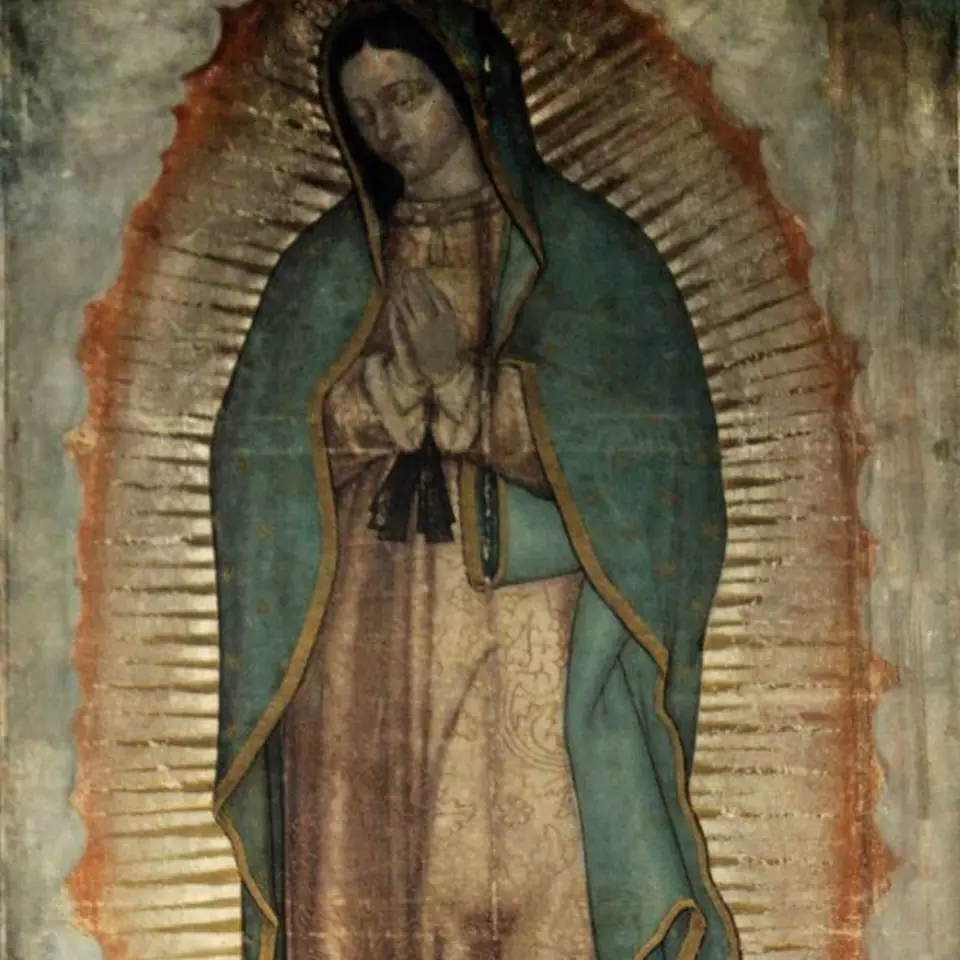
The question: “There's a record saying an Indigenous painter made it. Doesn't that settle it against a miracle?”
The Church's answer: That record does exist. And the decisive evidence on the skeptical side and the decisive evidence on the believing side have both gone unpublished — that is the real state of this case.
First the story. 1531 was the tenth year after the fall of Tenochtitlan. Indigenous society was collapsing under the violence of the conquest and epidemic disease, and the hill of Tepeyac had held a temple of the goddess Tonantzin. The four days recounted in the Nican Mopohua go like this. On December 9, Juan Diego Cuauhtlatoatzin met a woman on the hill and carried her words to Bishop Zumárraga, who did not believe him. On December 10 the bishop demanded a sign. But that same day his uncle Juan Bernardino collapsed with a fever called cocoliztli. Juan Diego went around the hill to avoid it while fetching a priest. On December 12 the woman appeared on that road, told him his uncle was already healed, and told him to gather the Castilian roses blooming on the hill in midwinter into his tilma. When he opened the tilma before the bishop the roses spilled out, and the image of the woman was on the cloth.
That cloth has survived for 495 years. In 1785 a worker spilled nitric acid on it; the agave fiber should have been eaten away, but only a small stain remains. On November 14, 1921, a bomb went off beneath the altar, bending an iron crucifix and breaking windows 150 meters away, while the tilma and the ordinary glass covering it were untouched. That bent crucifix is still on display.
What the Church has actually recognized: What Pope Benedict XIV approved in 1754 was liturgical veneration and a proper Mass. The supernatural origin of the image has never been declared an article of faith.
The pushback: “There was a public accusation in 1556.” — Francisco de Bustamante, the Franciscan provincial, attacked veneration of the image at Tepeyac head-on in a sermon on September 8 of that year, and in the inquiry Archbishop Montúfar opened, four witnesses testified that it was “painted by human hands.” One named the painter as “the Indian Marcos.” In the vast written output of Bishop Zumárraga, the man supposedly at the other end of the apparition, there is not one line about it. The missionary Sahagún wrote around 1576, with concern, that there had been a temple of Tonantzin at Tepeyac and that people still called the new Madonna by that name. And in 1982 José Sol Rosales, head of Mexico's national center for registry and conservation, examined the image under a microscope and concluded that it was “a Byzantine-style tempera painting,” with a glue ground and identifiable pigments.
If they press further: “Then hasn't the question been answered?” — No, for two reasons. First, the point of Philip Callahan's 1979 infrared photography was to distinguish later overpainting from the original image. He held that the face, the hands, the tunic, and the mantle show no underdrawing and no brushstrokes, and that the overpainting is confined to the angel, the moon, the gold rays, and the stars added later. It remains open that the pigments Sol Rosales detected are exactly those additions. Second, Sol Rosales's report was never published. The decisive evidence on the skeptical side can't be checked either, which is the same weakness the devotional material has. The decisive test would not be hard: non-destructive multispectral imaging would settle whether there is a ground layer. The basilica has not permitted it.
In one sentence: “The record that says ‘a human painted it’ and the photography that says ‘there is no underdrawing’ are both real. The test that would settle it hasn't been done, and what the Church approved is veneration, not origin.”