Miracles you can still visit · Question 7
Do people really get better at Lourdes? How many cures have been recognized?
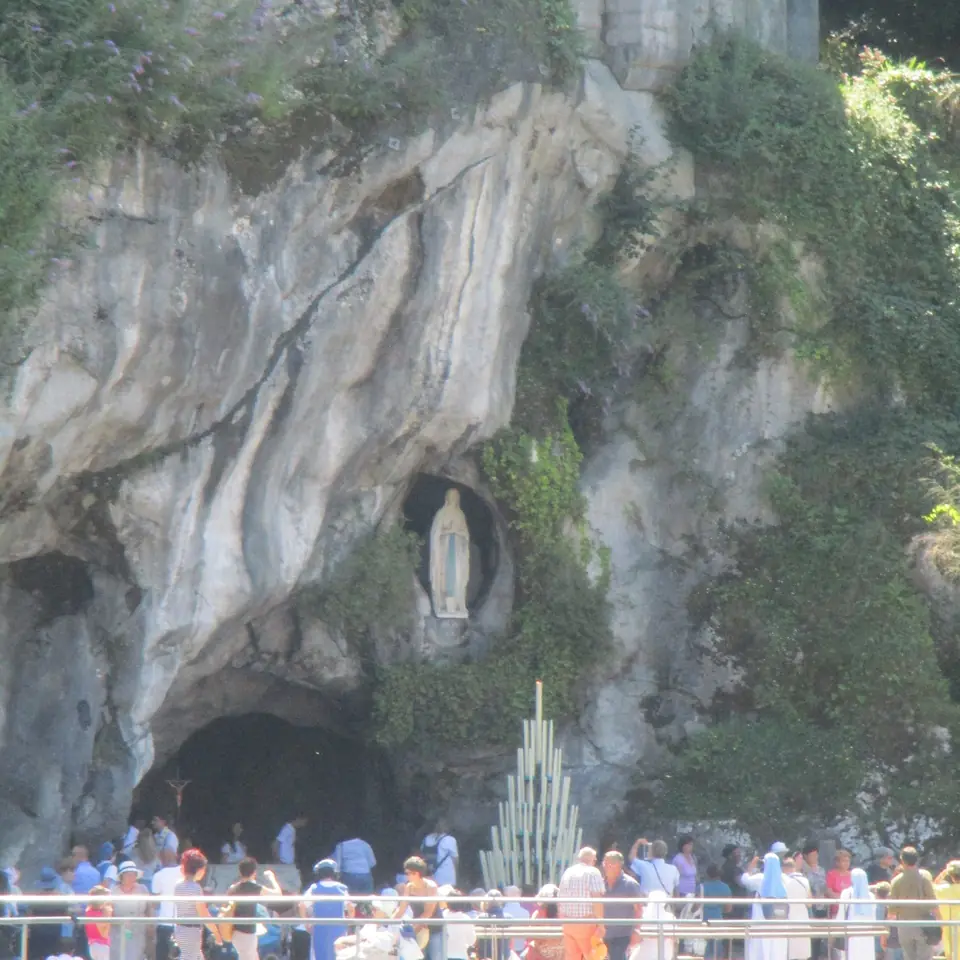
The question: “Millions of people go and only a few dozen are recognized. Aren't those just people who would have recovered anyway?”
The Church's answer: Let's fix the number first. As of 2026 it is 72. A good deal of the material still says 70. The seventy-first was John Traynor, an Englishman cured in 1923 and already recognized at Lourdes in 1926, which the Archbishop of Liverpool proclaimed on December 8, 2024 — the first in the English-speaking world. The seventy-second was Antonia Raco, announced on April 16, 2025.
The story begins like this. In 1858 Bernadette Soubirous was fourteen, and her bankrupt family was living in a single room that had once been a jail. She had asthma and could not properly read or write French. At home the family spoke the dialect of Bigorre. On February 11, out gathering firewood, she saw a woman in the grotto of Massabielle, and unable to call her by any name she said only aquerò in dialect — “that thing.”
Two scenes matter. On February 25 the woman told her to go to the spring and drink, and there was no spring, so Bernadette dug in the ground. At first it was mud; on the fourth try it was drinkable. The onlookers laughed at a child eating dirt. That spot is the spring at Lourdes today. On March 25 the woman gave her name: Que soy era Immaculada Councepciou — I am the Immaculate Conception. Bernadette did not know what the words meant and ran to her parish priest repeating them so she would not forget. What startled the priest was that this was the language of a dogma proclaimed four years earlier.
The review system belongs in the picture too. A medical bureau was set up in 1883 and an international medical committee added in 1947. Doctors are accepted without being asked whether they believe. More than 7,000 cases have been reported; 72 have been recognized.
What the Church has actually recognized: What the bishop of Tarbes recognized in 1862 was the authenticity of the apparitions. Each individual cure is a confirmation that it is “not explicable by medicine,” and declaring it a miracle belongs to the bishop of the patient's own diocese.
The pushback: “The sample is far too large.” — More than 200 million people have come since 1858. Against that denominator, 72 is not distinguishable from the statistical background of spontaneous remission. A 2014 study in a journal of medical history reviewed the records of 411 people from 1909–14 and the 25 recognitions from 1947–76 and pointed to thin diagnostic records, insufficient follow-up, and the share of psychogenic illness. And from 1976 to 2006 there were thirty years with zero recognitions. That may mean recognitions vanished as medicine grew precise. There is not one case of a severed limb growing back.
If they press further: “So is the recognition process itself sloppy?” — Rather the opposite. Keeping only 72 out of 7,000 means the review is working. Religious institutions that run a falsifiable procedure on themselves are rare. There is a reason for the thirty-year gap as well: after 2006, when the category of judgment was changed to “a cure not explicable by medicine,” confirmed cases began appearing again. Individual cases leave material behind. In 1963 Vittorio Micheli had a sarcoma dissolving his pelvic bone and was not even a candidate for treatment, and the X-rays from 1964 to 1971 record the bone rebuilding itself. The international medical committee reviewed it twice and found unanimously that it could not be explained. In 1987 Jean-Pierre Bély had multiple sclerosis, was bedridden, and had been assessed as 100 percent disabled with a caregiver's allowance.
In one sentence: “‘There are seventy-two cures medicine can't explain’ and ‘God did it’ are different statements. The Church confirms the first and professes the second in faith.”