Miracles you can still visit · Question 8
Seventy thousand people saw the sun at Fatima. Why isn't there a single photograph?
The question: “Hundreds of people were standing there with cameras. If there's no genuine photograph, didn't it fail to happen?”
The Church's answer: It is true that there is no photograph. And the widely circulated “photo of the miracle of the sun” has been shown to be a different solar phenomenon, photographed in a different village about eight years later. Hide that and the pilgrim will find it out alone on the internet later.
So this entry is better understood not as “a miracle that is still there” but as “a place where the testimony is still there.”
The background runs like this. The Portuguese First Republic, established when the monarchy fell in 1910, dissolved religious orders and banned religious education. At the same time the country entered the First World War, its young men were dying, and food was short. And the apparitions do not begin in 1917. In 1916 an “Angel of Peace” is said to have appeared three times to three children. Lúcia was ten, Francisco nine, and Jacinta seven.
The part most often left out is August. On the morning of August 13, Artur de Oliveira Santos, the administrator of Ourém, put the children in his car and took them away. He coaxed them, threatened them, and jailed them with other prisoners, saying they would be boiled in oil if they did not tell the secret. The children did not tell. Prisoners in the same room later testified that the children cried and then all prayed the Rosary together. They were released on August 15, and so that month's apparition took place on August 19 at Valinhos.
October 13 had been announced three months in advance. Between 50,000 and 70,000 people gathered in pouring rain, and skeptical journalists had come to mock. And two of the three children died soon after — Francisco on April 4, 1919, and Jacinta on February 20, 1920, of Spanish influenza. Both were canonized in 2017.
What the Church has actually recognized: What the bishop of Leiria declared on October 13, 1930, was that the events are “worthy of belief,” together with permission for public devotion. He did not establish that they were supernatural. That he investigated for thirteen years and stopped at that level is the weight of this judgment.
The pushback: “Stare at the sun long enough and you see things like that.” — Auguste Meessen, a physicist at the Catholic University of Louvain, explains the color changes and the “dancing” by retinal afterimages and photoreceptor bleaching. Others cite a silver disk produced by thin cloud, refraction through dust and water vapor, and sun dogs. Some point out that the testimonies do not agree with one another, and that not everyone saw anything.
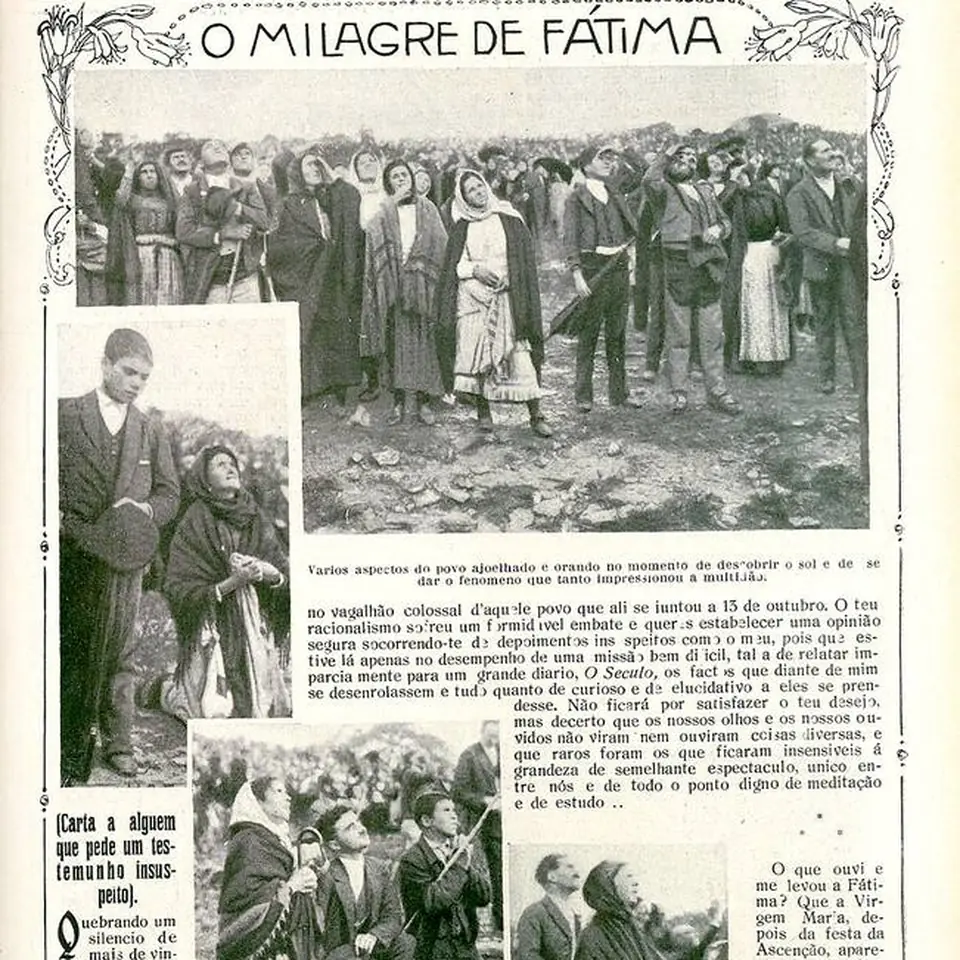
If they press further: “So was it all an optical illusion?” — Some things are left over that afterimages don't explain. The date and hour had been announced three months earlier, and the same phenomenon was seen at Alburritel, 18 kilometers away. Crowd psychology does not travel that distance. Avelino de Almeida, a reporter for the anticlerical daily O Século, wrote an on-the-spot account, and it ran in an illustrated magazine that year alongside photographs of the crowd. What those photographs show is not the sky but people looking at the sky. There is also a good deal of testimony that clothing soaked by the downpour and the mud dried in moments. And out of tens of thousands, not one report of blindness or retinal damage. Stanley Jaki, a theologian and physicist, offered a middle position: the miracle would be that refraction through ice crystals occurred precisely at the announced moment.
In one sentence: “There is no physical evidence, only testimony and an announcement made in advance. Which is why the Church too said only ‘worthy of belief’ and not ‘supernatural.’”