Miracles you can still visit · Question 3
Did the feast of Corpus Christi really begin with a miracle?
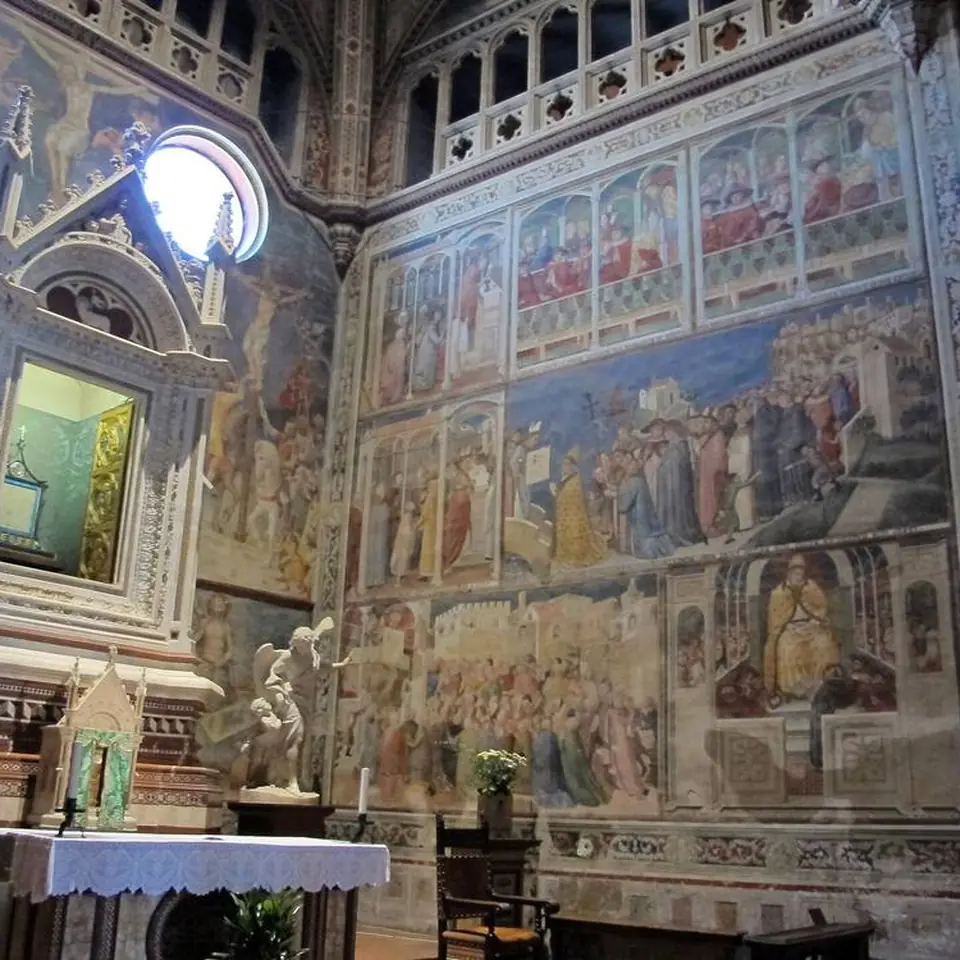
The question: “I was taught that a host bled at Bolsena and that's how the feast came about. Is that true?”
The Church's answer: Here the pushback is stronger. But knowing that doesn't give you less reason to go to Orvieto — it makes the reason clearer.
The story handed down runs like this. In 1263, a Bohemian priest, Peter of Prague, on pilgrimage to Rome, stopped at the church of St. Christina in Bolsena. By his own admission his faith in Christ's real presence in the Eucharist was wavering. When he spoke the words of consecration and lifted the host, blood is said to have flowed and soaked the corporal.
To see why the story sounds plausible you have to look at the background. In the eleventh century Berengar of Tours interpreted the real presence in the Eucharist as symbolic, setting off the first Eucharistic controversy in the Western Church, and the aftershocks ran for two hundred years. The priest of 1263 was not personally weak; he was standing in the middle of his era's argument.
And people connect. St. Juliana, a nun of Liège in Belgium, spent nearly forty years persuading anyone she could that a feast honoring the Eucharist should be established. The archdeacon of Liège at the time was Jacques Pantaléon of Troyes, and he believed Juliana's visions came from God. That archdeacon became Pope Urban IV in 1261. Rome was unsettled, so the papal court was staying at Orvieto, and Bolsena was close by.
In 1264 the Pope established the feast of the Most Holy Body and Blood of Christ for the whole Church by the bull Transiturus de hoc mundo. And he gave the work of composing the Mass and Office for that feast to Thomas Aquinas, then at the Dominican house in Orvieto.
An analogy — the hymns we still sing came from there
Tantum ergo, sung at Benediction, is the last two stanzas of Aquinas's Pange lingua. Panis angelicus is the sixth stanza of Sacris solemniis, and O salutaris hostia is the last two stanzas of Verbum supernum. The sequence for the feast, Lauda Sion, came from the same desk. Even if the miracle can't be proved, the fact that the hymns we sing every week were written at Orvieto is not tradition. It is fact.
What the Church has actually recognized: There is no document in which the Church judges the miracle itself. What remains is the corporal as a relic, the veneration paid to it, and the establishment of the feast as a separate fact.
The pushback: “There is not one line about a miracle in the bull the Pope wrote.” — This is the sharpest objection. If that miracle had been the occasion, it makes no sense. Contemporary papal biographies describe Urban IV's stay at Orvieto in detail and never mention Bolsena. Documentary evidence appears only from the fourteenth century, and the “bloodstained corporal” tale is common in earlier European collections of legends. These objections are set out by the Catholic Encyclopedia itself.
If they press further: “So was the whole thing invented?” — That is hard to say too. The corporal survives as a physical object, and by 1337 the local tradition was established enough that the reliquary was commissioned from the Sienese goldsmith Ugolino di Vieri. The eight enameled scenes on that reliquary are the earliest surviving pictorial account of the event. That said, no modern analysis of the stains on the corporal has ever been carried out.
In one sentence: “The evidence on the miracle side is the weakest on this list. But that the feast and Tantum ergo came from there is not tradition. It is fact.”