Miracles you can still visit · Question 2
Siena has a host that hasn't decayed in 296 years. Isn't that just well-dried bread?
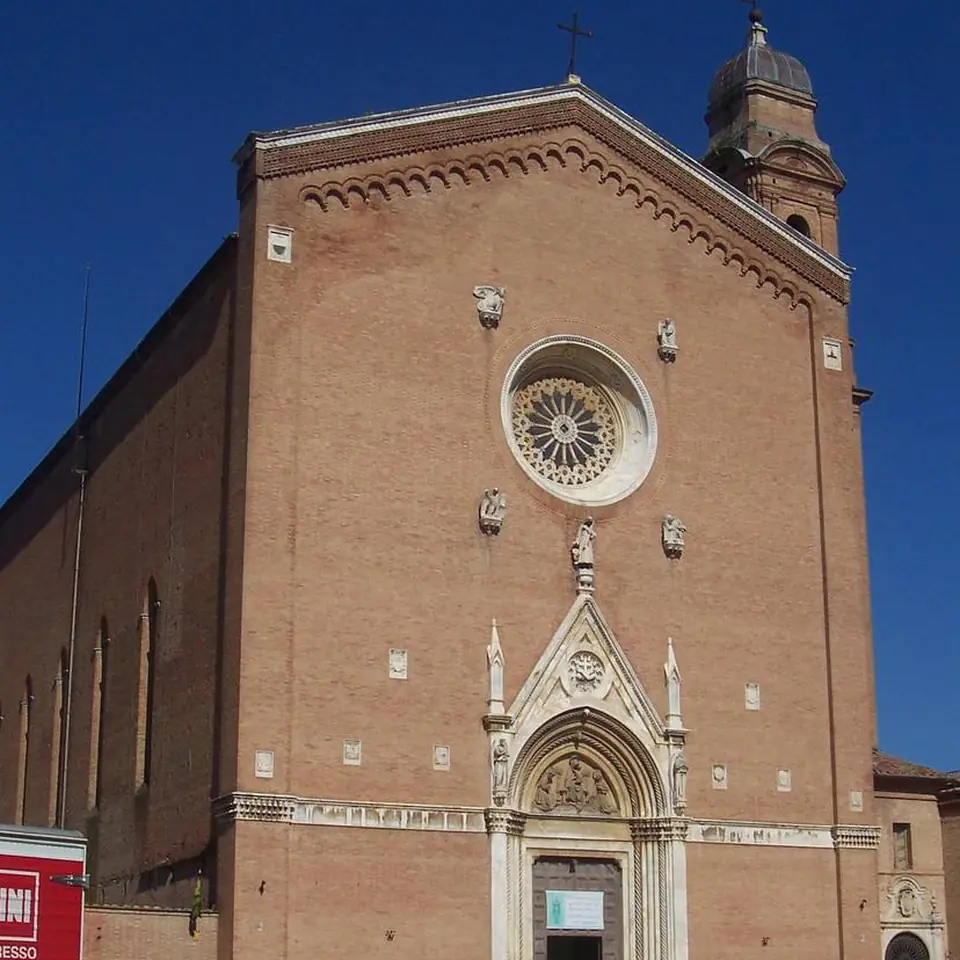
The question: “Wheat bread keeps for a long time when it dries out. Isn't calling that a miracle a stretch?”
The Church's answer: A fair objection. Except that in this case a control experiment was actually run.
On the night of August 14, 1730, the vigil of the Assumption, a thief entered the Basilica of St. Francis in Siena and carried off the entire gold ciborium from the tabernacle. Consecrated hosts were inside — 348 whole and 6 broken. Three days later all of them turned up in the offering box of the church of Santa Maria di Provenzano. They were tangled with dust and cobwebs, but the hosts were intact. The thief was never caught.
By the ordinary rule, recovered hosts should be distributed in Communion. But they were soiled and could not be, and while they were being cleaned it emerged that they were not spoiling with the passage of time. So they were left, and people began to watch.
On April 14, 1780, the minister general of the Franciscans, Fr. Carlo Vipera, consumed one of the hosts himself. Having reported it fresh and unspoiled, he directed that the rest be preserved rather than divided again. Then in 1789 the archbishop of Siena sealed unconsecrated hosts in a box under the same conditions. When a commission of scholars opened it ten years later, there was nothing inside but insects and crumbs.
In 1914, with the authorization of Pope St. Pius X, a commission of specialists in food science, hygiene, chemistry, and pharmacy from Siena and Pisa examined them. Their finding: “Flour is an optimal medium for microorganisms, pests, and lactic fermentation, yet the particles from Siena are in perfect condition despite every unfavorable circumstance.” They were tested again in 1922, 1950, and 1951, with the same conclusion.
What the Church has actually recognized: What the Pope authorized was an examination. The fact of preservation was confirmed and veneration permitted; a supernatural origin was not declared.
The pushback: “The 1789 experiment is not a modern standard.” — There is no record of temperature or humidity, and no way to confirm that the two boxes were truly under the same conditions. The people running it were an interested party. And the last examination was in 1951, seventy-five years ago.
If they press further: “Still, a tabernacle is a sealed container, so wouldn't things keep?” — A tabernacle is not a sealed container. A priest opens and closes it constantly, and Siena has humid summers. The 1914 commission also determined that the hosts were made from coarsely sifted flour, and coarse particles favor microorganisms rather than hindering them.
In one sentence: “The explanation that ‘dry bread keeps’ was already tested in 1789, and the unconsecrated batch rotted within ten years. But the testing has been stopped for seventy-five years.”