Miracles you can still visit · Question 1
Is there really thirteen-hundred-year-old flesh and blood at Lanciano?
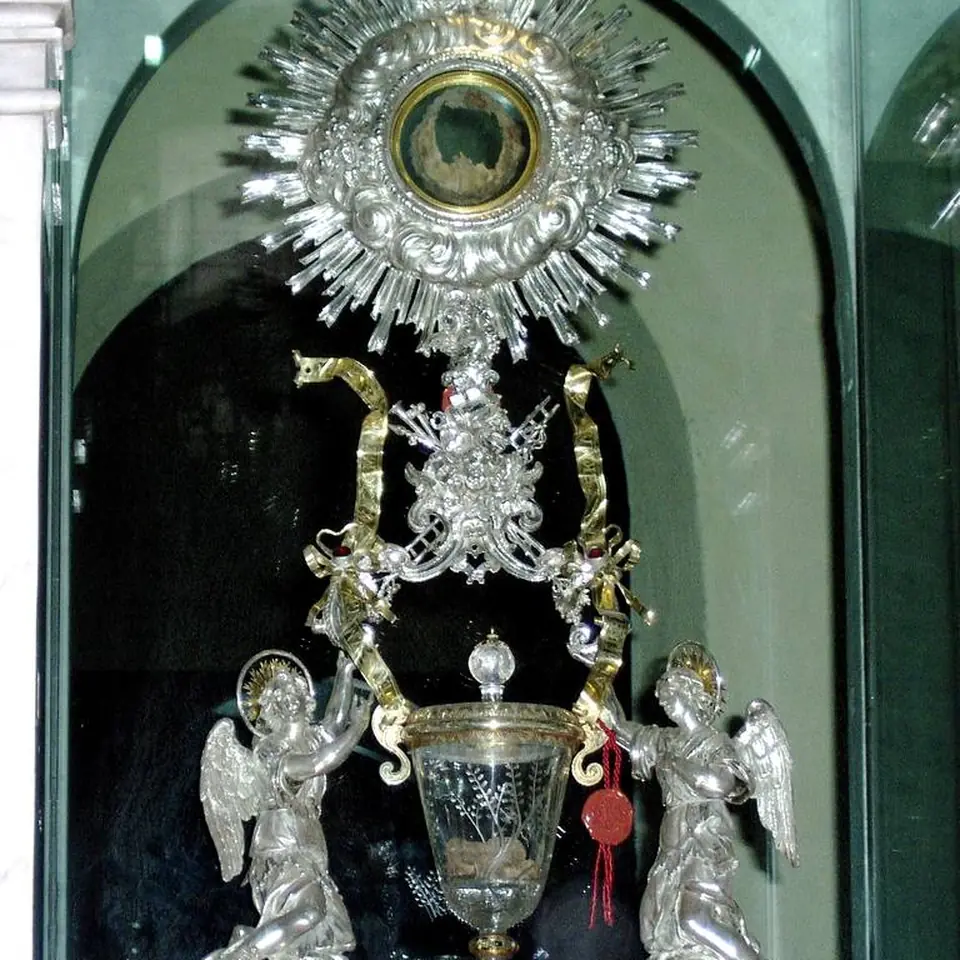
The question: “A piece of eighth-century flesh is still on display in a church and it passed scientific testing? How is that supposed to work?”
The Church's answer: The object is genuinely there. In Lanciano, in the Italian region of Abruzzo, a silver monstrance made in Naples in 1713 stands on the high altar of the Church of St. Francis, and inside it a thin piece of flesh lies spread open. In a rock-crystal chalice at its foot are five clots of hardened blood. It has been displayed in this form since 1923.
The story handed down runs like this. Early in the eighth century, a Basilian monk celebrating Mass in the church of St. Legontian saw the host become flesh and the wine become blood. The Basilians used the Greek rite, and in those years the iconoclast controversy in Byzantium was driving Greek monks who wanted to save the images into southern Italy in large numbers. And the word “transubstantiation” did not yet exist. The Church adopted that term officially in 1215. What shook that monk was not heresy but a question that had not yet been given words.
The testing happened in 1970–71. Odoardo Linoli, head of pathological anatomy at the hospital in Arezzo, examined it together with Ruggero Bertelli, emeritus professor of human anatomy at Siena, and the findings were human heart muscle, blood type AB, and no trace of preservative treatment. The report appeared in an Italian scientific journal in 1971.
What the Church has actually recognized: This was a diocesan matter, initiated by the archbishop of Lanciano with Rome permitting the examination. There is no document in which the Holy See declares the event supernatural. What the Church has allowed is veneration of the relic and investigation of it.
The pushback: “The testing was thin.” — It did not appear in an international peer-reviewed journal, and there has been no independent re-examination in fifty-five years. The sample slides have never been released. There is a sharper point too. A 2025 study in a forensic journal argued that bacteria also produce AB antigens, so an AB result on an old sample cannot establish that the material is human blood. That objection came from a Catholic scientist.
If they press further: “Then did someone manufacture it in the eighth century?” — Linoli thought that was difficult too. The heart is a hollow organ, so taking a uniform, continuous thin slice takes real dissection skill. It is also unusual for tissue structure to survive twelve centuries exposed to air and insects with no preservative. A scholar on the other side published a reply in the same journal in 2025: there was no genetic testing in the 1970s, and serological blood typing is a legitimate technique that has been used to reconstruct human history, so the mere possibility of contamination is not reason enough to throw the whole thing out.
In one sentence: “The object is real and the 1971 examination was real. But nobody has tested it again in fifty-five years, so both sides are arguing from old material.”