Miracles you can still visit · Question 4
I heard Pope Francis recognized a Eucharistic miracle.
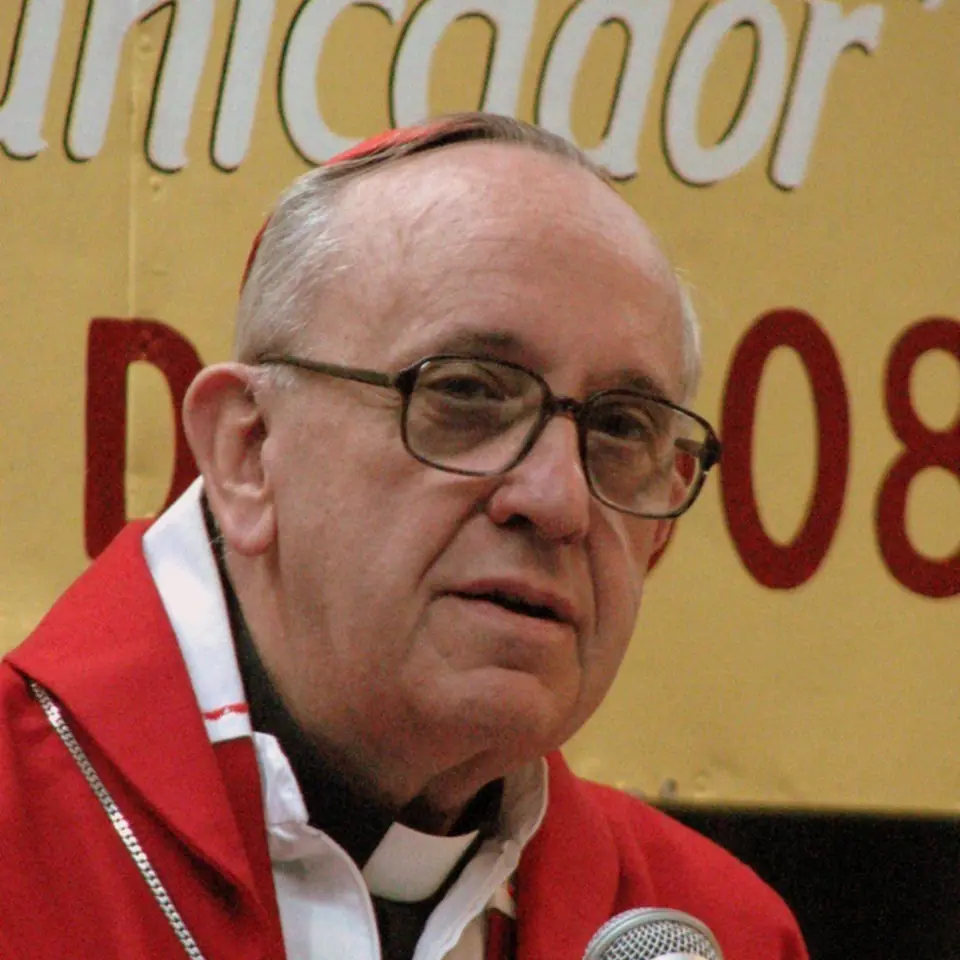
The question: “In Buenos Aires he ordered the investigation himself and heart tissue turned up. Isn't that an officially recognized miracle?”
The Church's answer: It is true that he ordered the investigation. But the archdiocese has never declared the event a miracle. That difference is the whole of this entry.
And it was not once but three times. Three different things happened at the parish of Santa María in 1992, 1994, and 1996. On May 1, 1992, fragments of a host left on the corporal were placed in water in the tabernacle as the rules require, and a week later they had turned red. On July 24, 1994, drops of blood were seen running down the side of the ciborium during a children's Mass. On August 15, 1996, a parishioner dropped a host, and Fr. Alejandro Pezet put it in a bowl of water in the tabernacle; when it was opened on August 26 it had not dissolved and a red stain had spread across it.
The auxiliary bishop at the time was Jorge Mario Bergoglio, the future Pope Francis. He did not hurry. He had photographs taken and the material preserved as it was, and only in 1999 did he permit a sample to be taken. The sample went to Frederic Zugibe in New York, formerly chief medical examiner of Rockland County and a cardiac forensic pathologist, and it was submitted without telling him where it came from. His finding was heart muscle from the left ventricle, severe trauma, inflammation, and white-cell infiltration. The result was reported to Cardinal Bergoglio on March 17, 2006, and he became Pope seven years after that.
What the Church has actually recognized: What the archdiocese acknowledged is that the events and the findings of the investigation exist. The phrase “a miracle recognized by Pope Francis” is not accurate. What he did was order an investigation.
The pushback: “The chain of custody was broken.” — The host sat in a bowl of water and a tabernacle for three years. There is no controlled record of what got into it in that time. And there is an experiment published in 2024. Unconsecrated wheat hosts were left near the floor for several days and then moved into tap water, and in about fifteen percent of them a distinct red area grew after seven to ten days. Microscopy and molecular biology identified fungi and bacteria. Several kinds of non-human genetic material also turned up in unconsecrated hosts.
If they press further: “Then was the heart tissue Zugibe saw bacteria too?” — No. The bacteria that produce red pigment are rod-shaped and do not look like heart muscle under a microscope. In the sample in question, muscle fibers and the arrangement of nuclei were reported. Put plainly: Zugibe may honestly have seen genuine heart tissue, and at the same time nobody may know where that tissue came from. The two objections do not knock each other down.
In one sentence: “What the Pope did was order an investigation, not grant recognition. The analysis was blind as to origin, but where the sample had been for three years was never controlled.”