Miracles you can still visit · Question 10
When you see an incorrupt saint, are you looking at the body itself?
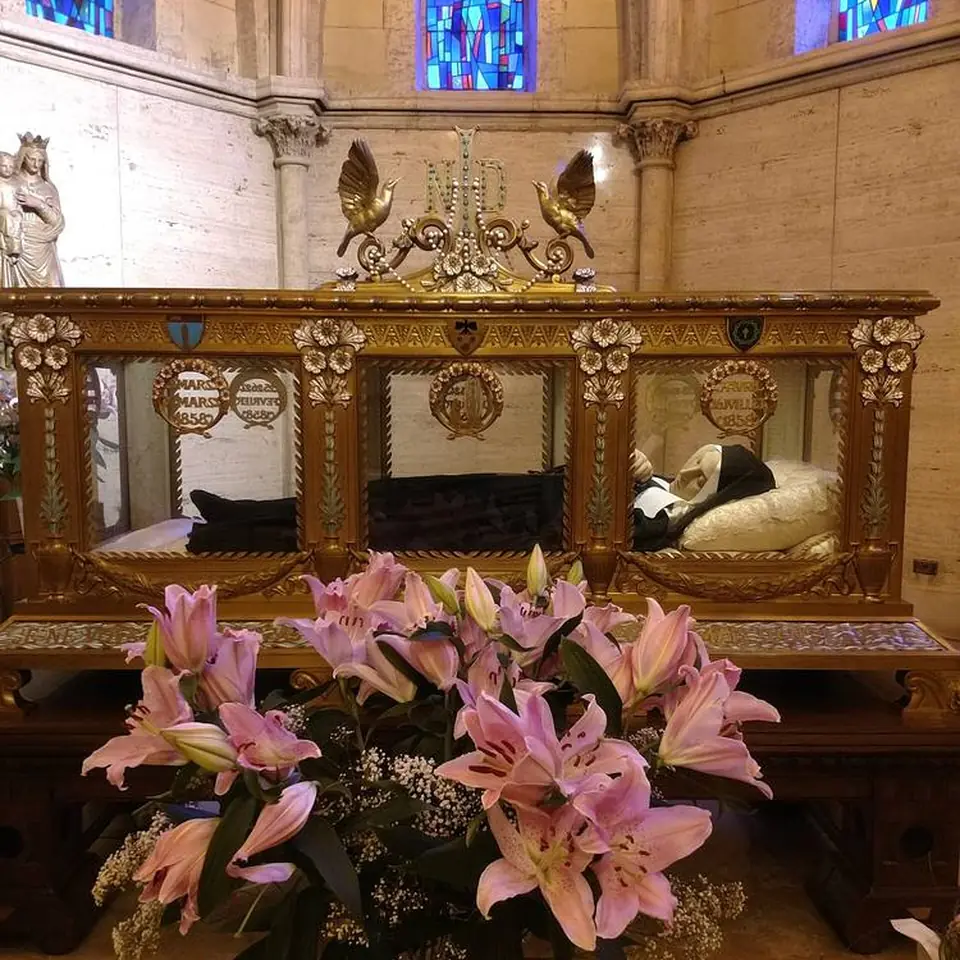
The question: “The saint's face in the glass case is said to be intact. Has it really not decayed?”
The Church's answer: Mostly, no. Bernadette, St. John Vianney the Curé of Ars, Padre Pio, Carlo Acutis — the faces are wax or silicone. And it isn't the Church that hid this. It is all written down in the exhumation reports the Church itself left behind.
Bernadette was exhumed three times. When the coffin was opened on September 22, 1909, thirty years after her death, the crucifix and rosary buried with her had rusted while the body was reported intact. The second report, of April 3, 1919, is far more specific: “The body is practically mummified and covered with a distinct layer of salts, apparently mold spots and calcium salts. The skin has been lost in places but remains over most of the body.” Dr. Comte removed ribs to serve as relics and noted that the firm mass in the chest cavity was the liver, and that its state of preservation was remarkable.
At the third exhumation, on April 18, 1925, the doctors wrote “supple and of almost normal consistency” while at the same time recording the discoloration of the face and the thinning of the nose. Since she was to be placed in a glass reliquary for pilgrims, casts of the face and hands were taken and covered with wax. The reason is in the report too: the face was darkened, and they were concerned it would repel pilgrims. The wax was made by Pierre Imans, a mannequin maker in Paris.
For Carlo Acutis, the bishop of Assisi said it first: “The body was found in the normal state of transformation typical of a corpse.” The face was reconstructed in silicone and the heart enshrined separately as a relic. Acutis was canonized on September 7, 2025, together with Pier Giorgio Frassati, by Pope Leo XIV.
What the Church has actually recognized: Nothing. In beatification and canonization procedures, the state of preservation of the body is not an item under review. The examination of miracles concerns cures only. The Church has never defined “incorruptibility” as a miracle.
An analogy — preservation isn't a sign; it's a way of honoring
When a museum hangs an old painting behind glass and lowers the lights, it isn't because the painting is mysterious. It is so that we can go on looking at it together. Placing a body in a glass reliquary and restoring the face sits in the same place. It is not the manufacture of a sign but the continuation of honor.
The pushback: “Natural preservation is common.” — Saponification, cold and dry burial environments, mineral salts in the soil, embalming. Mummification is not extraordinary. And if the face is wax, there is no way to verify “it didn't decay” with your eyes. What the pilgrim sees is not a preserved face but a restored one.
If they press further: “Then does it mean nothing at all?” — That goes too far. That a body buried in 1879 was “supple and of almost normal consistency” forty-six years later is not ordinary, and the finding that the internal organs, which go first, were still there is hard to account for by the process of decay. Whether to call that a miracle, though, is something the Church has never settled.
In one sentence: “The ‘incorrupt saint’ is not a sign but one way of honoring relics. And that the face is wax was written down by the Church before anyone else said it.”