Miracles you can still visit · Question 11
Were Padre Pio's stigmata wounds he made himself?
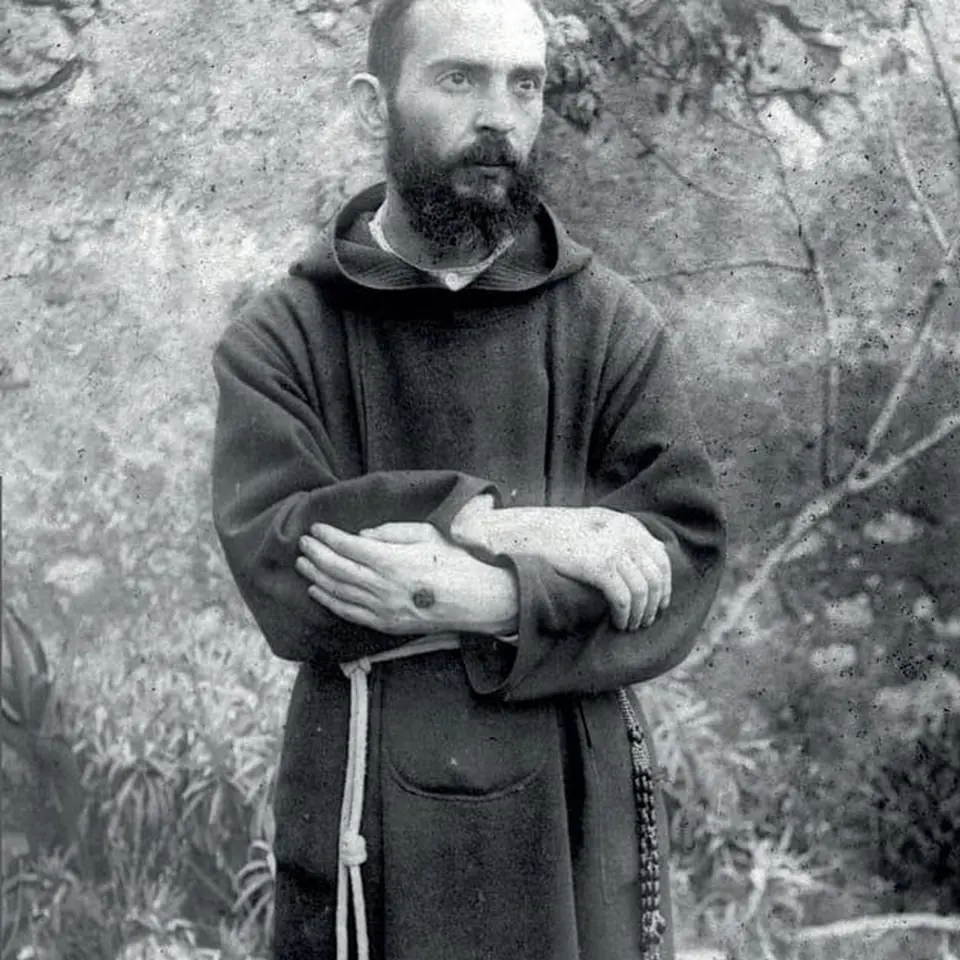
The question: “A record turned up of him secretly buying acid from a pharmacy. Doesn't that make them manufactured wounds?”
The Church's answer: That record is real. And there is something more startling still. The Church silenced him for two years and two months.
Francesco Forgione was born in 1887 to a farming family at Pietrelcina in southern Italy, entered the Capuchins at fifteen, and took the name Pio. In early August 1918 he first reported “invisible wounds,” and on September 20, while making his thanksgiving after Mass, wounds appeared in his hands, his feet, and his side. They lasted fifty years and disappeared with his death on September 23, 1968.
The Church sent doctors — chosen for their skepticism. In July 1919, Amico Bignami, professor of pathology at the University of Rome, came on assignment from the Holy Office, picked for his medical standing and his skeptical cast of mind. His finding cuts both ways. By a test in which bandages were sealed and then checked, he ruled out self-infliction. At the same time he raised the possibility that a necrosis of the skin begun by autosuggestion had been kept from healing with a substance such as tincture of iodine, and he acknowledged that the wounds were genuine and that their persistence was not explained.
What the Church has actually recognized: From 1924 to 1931 the Holy See issued several public statements denying that the phenomenon was connected to a supernatural cause. In May 1931 he was forbidden every priestly ministry except the Mass, and even the Mass had to be celebrated alone inside the friary. The ban was lifted in July 1933. The canonization of 2002 rests on a miracle of healing examined separately from his virtues. It did not adjudicate the supernatural character of the stigmata.
The pushback: “There is a record of a carbolic acid purchase.” — Material found in the Vatican archives by the historian Sergio Luzzatto and published in 2007. By the testimony of the pharmacist Maria De Vito, in 1919 Padre Pio bought four grams of carbolic acid without a prescription and asked her to keep it quiet. Agostino Gemelli, the physician who founded the Catholic University of Milan, judged the phenomenon “a product of suggestion.”
If they press further: “Then hasn't it all been explained?” — Three things are left. First, Gemelli never saw the wounds. Padre Pio would not show them without his superior's written permission, so Gemelli wrote his assessment without looking. Second, there is another explanation for the carbolic acid: the Spanish flu was going around in 1918–19, and the friary's account at the time was that it was for sterilizing syringes; the doctors who actually examined him reported that the wounds were perforating in form and showed none of the appearance of a caustic burn. A purchase record is not a usage record. Third, the wounds continued after the 1931 ban — through two years with no public to show them to and no approval from the Church.
In one sentence: “The Church doubted him first and shut him down for more than two years. What he did after that silence was build a hospital.”