Miracles you can still visit · Question 12
Is the Shroud of Turin a miracle the Church recognizes?
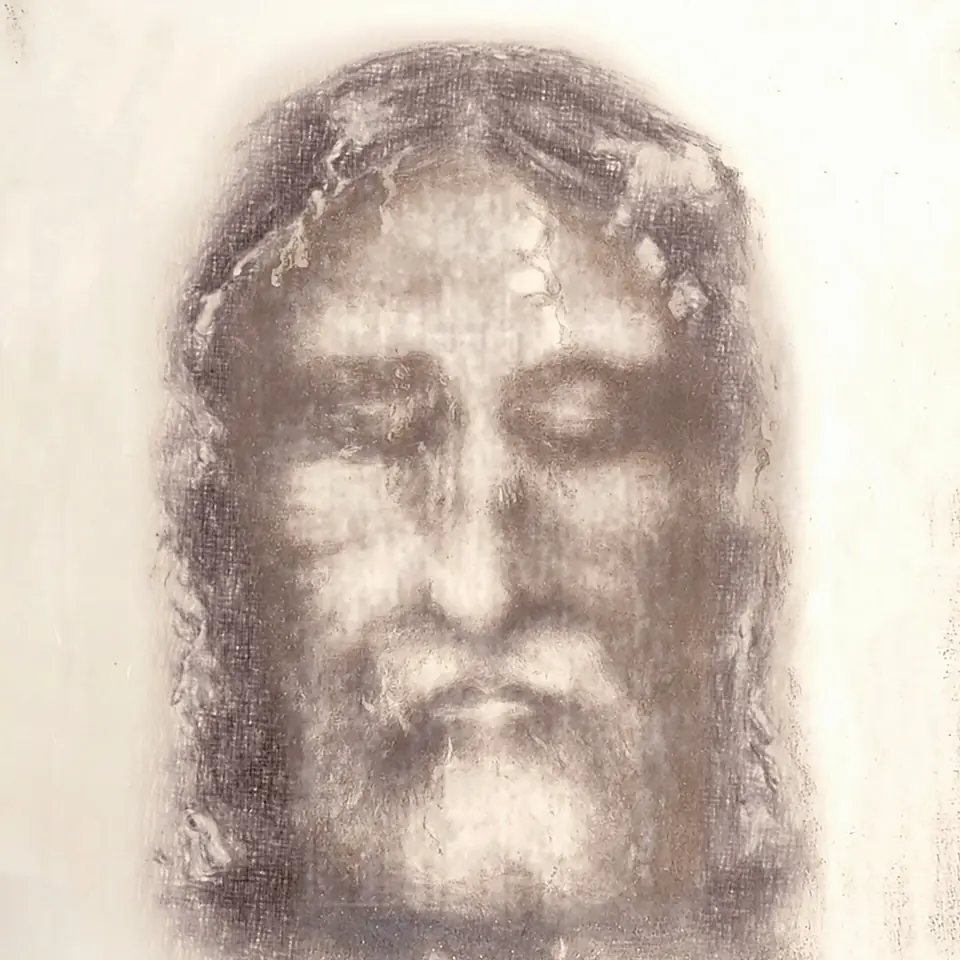
The question: “It's called the cloth with Jesus's face on it. Hasn't the Church recognized it as genuine?”
The Church's answer: No. No Pope has ever declared it authentic. In 1998 John Paul II called the Shroud “an icon that is an object of devotion, not of faith,” and stated that the Church has no competence to judge its authenticity and leaves that question to science.
The road this cloth has traveled is worth knowing too. The first record history confirms is at Lirey in France in the 1350s. The knight Geoffroi de Charny presented it as the true burial cloth of Christ, and there is no record of where he got it. Between Christ's burial and that moment there is a gap of 1,300 years. It passed to the House of Savoy in 1453, and in the fire at Chambéry in 1532 the molten silver of its case ran down and burned through the folded cloth. Those marks are still there. It was moved to Turin in 1578 and has been there since.
Modern study begins with a photograph. On May 28, 1898, the amateur photographer Secondo Pia took the first one, and in the darkroom, when he lifted out the negative, a faint smudge resolved into a human face. The image on the cloth behaves like a negative.
What the Church has actually recognized: Nothing. And yet it is almost always presented as an officially recognized miracle.
The pushback: “It was dated in 1988.” — Three laboratories, at Oxford, Arizona, and Zurich, measured separately, and the result published in Nature in 1989 was between 1260 and 1390, at 95 percent confidence. That matches the 1350s appearance at Lirey exactly. In 1389 Pierre d'Arcis, bishop of Troyes, sent the Pope a memorandum saying “a painter has confessed that he made it.” The origin point of the skepticism is a Church document.
If they press further: “So is the story over?” — Not yet. A 2005 study argued that the composition of the sample differed from the main body, and in 2019 researchers who obtained the raw data through a legal claim against the British Museum demanded a re-measurement, holding that the reported values had been transformed by an unpublished method and that the data were heterogeneous. A 2022 paper measured the degradation of the linen fibers by X-ray scattering and estimated the first century. But the current turned again in 2026. A textile analysis of two fragments cut from the 1988 sample concluded that the fragments match the main body and that there is no evidence of contamination — which weakens the ground for the objection that “a medieval repair was what got cut.”
In one sentence: “Not a miracle recognized by the Church. It is the most studied relic there is, and the argument changes direction every few years.”