0 / 12 answered

Kept in this browser alone

Faith — what we believe

The human person and original sin

Choose an option and you are told at once whether it was right. The answer and the reason wait behind “Show the answer”.
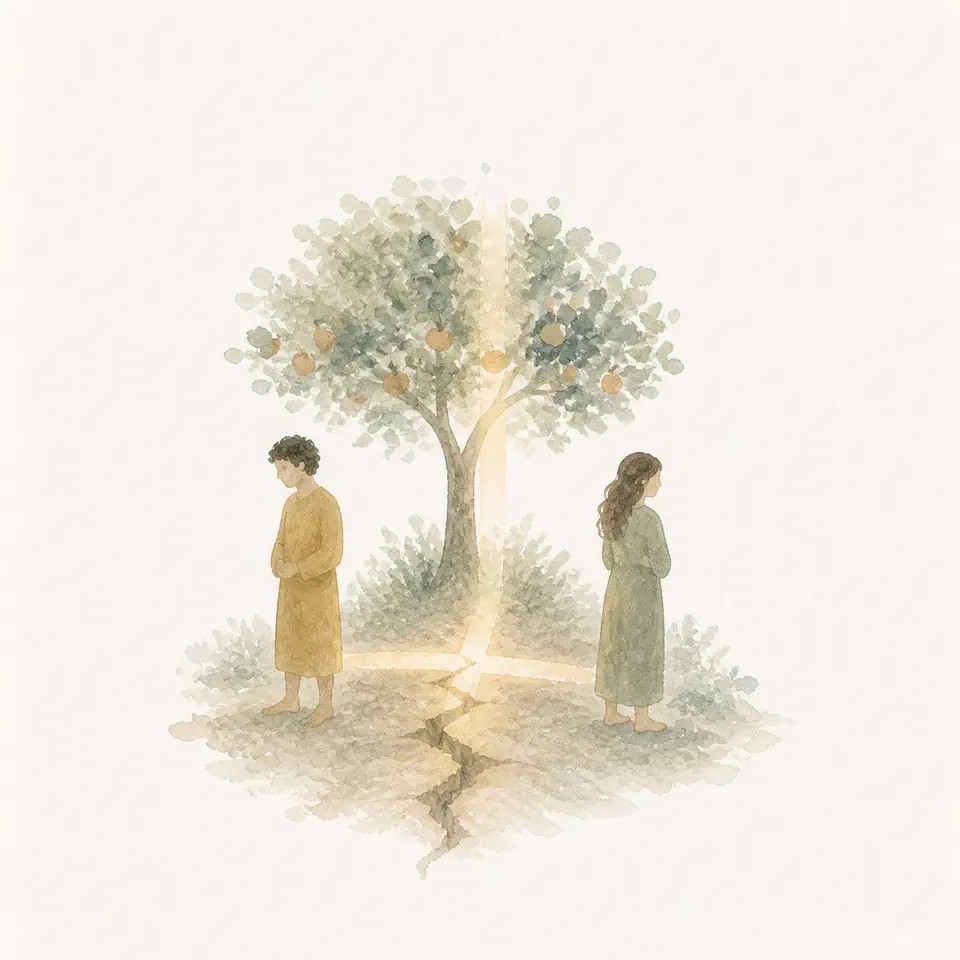
A watercolor of a man and a woman standing apart on either side of a fruiting tree, heads bowed and turned away, as light falls across the cracked ground
  1. What does it mean to say that a human being is created “in the image of God”?

    Show the answer

    Answer ③ That a human being is a person who knows, loves and decides freely, and so can live in communion with God

    The image is not about what we look like; it is about being a person. Take it the way the first choice does, and you drag God down into a human shape — and unlike the fourth, this dignity already belongs to every human being before baptism.

    Catechism of the Catholic Church 355-357

  2. How do body and soul stand together in a human being?

    Show the answer

    Answer ③ A human being is one being who is both body and soul, and the soul is the form that makes that body a human body

    The Church sees a human being as body and soul made one. The first and the second are dualism, lowering the body to a prison or a husk, and the fourth is materialism, erasing the soul altogether. Because the body is not a part of the person but the person himself, we believe in the resurrection of the body.

    Catechism of the Catholic Church 362-365

  3. A human soul is not inherited from one's parents; God creates it directly.

    Show the answer

    Answer ① Yes

    Yes. We receive our bodies from our parents, but the soul is made directly by God. That is why the soul does not fade away at death, and why on the last day it will be one with the body again.

    Catechism of the Catholic Church 366

  4. What does the Church teach about man and woman?

    Show the answer

    Answer ② Both are equally the image of God and hold the same dignity; they were made for each other, called to help each other and to become one

    The creation account sets man and woman side by side as the image of God. Ranking one above the other, as the first does; turning the difference into a result of sin, as the third does; wiping the difference away, as the fourth does — none of these is what Scripture says.

    Catechism of the Catholic Church 369-372

  5. Before sin entered the world, what was the “original holiness and justice” that human beings enjoyed?

    Show the answer

    Answer ④ A state of harmony and friendship with God, given freely as his grace

    This state was not a human achievement but God's gift. The third mistakes it for a constraint that made sin impossible; but human beings were free from the start, and it was that very freedom that was put to the test.

    Catechism of the Catholic Church 374-376, 396

  6. In the account Scripture gives, where did the first human sin begin?

    Show the answer

    Answer ① In pride and disobedience: not trusting God's goodness, and reaching to be like God without him

    The root of the first sin is doubting God and putting oneself in his place. The second is an old misunderstanding, and making knowledge itself the sin, as the third does, turns God into the enemy of knowing. The temptation came from outside, but the choice was a free human one, so it is not the fourth either.

    Catechism of the Catholic Church 397-398

  7. The serpent and the tree in Genesis 3 are only a tale the ancients invented, so they do not hand on anything that actually happened at the beginning of the human race.

    Show the answer

    Answer ② No

    No. The Church grants that the passage is written in figurative language, and still teaches that it hands on a real event at the beginning of human history. Recognizing the dress a story wears does not make the event inside it disappear.

    Catechism of the Catholic Church 390

  8. What kind of being is the devil who tempted the human race?

    Show the answer

    Answer ④ An angel created good, who turned his back on God by his own choice

    God has never made anything evil. What is evil in the devil comes not from the nature he was given but from a choice he has never taken back. The first sets good and evil up as two equal roots — a dualism that undermines God's sole sovereignty.

    Catechism of the Catholic Church 391-395

  9. In what sense is original sin called a “sin”?

    Show the answer

    Answer ② Not as an act we committed but as a state of nature handed on to us, a nature deprived of grace — so in an analogical sense, not the proper one

    Original sin is not something we did; it is the place we find ourselves in the moment we are born. Reading it as a sin of our own, as the first does, or as taking someone else's punishment, as the third does, makes God out to be unjust.

    Catechism of the Catholic Church 404, 405

  10. Original sin ruined human nature so utterly that not even the power to recognize the good and want it is left in us.

    Show the answer

    Answer ② No

    No. Our nature is wounded, but it has not collapsed. We can still recognize the good and want it; what we cannot do, without grace, is reach it fully. The Church has never accepted the claim that human nature is corrupt through and through.

    Catechism of the Catholic Church 405, 406

  11. After baptism, what becomes of original sin and of the mark it left?

    Show the answer

    Answer ① Original sin is truly taken away, but the leaning toward sin, called “concupiscence”, remains and becomes the struggle of a lifetime

    Baptism really does take original sin away, but the pull toward sin remains, left to us as the ground on which we are to fight and win. Take it as the second does, that everything has gone, and the struggle inside you comes as a shock; the third shrinks the power of baptism to a covering. And unlike the fourth, an attraction we have not yet consented to is not a sin.

    Catechism of the Catholic Church 405, 1264

  12. When the Church speaks of original sin, what news does it hand on along with it?

    Show the answer

    Answer ② That God promised salvation on the very day sin entered, and that the obedience of Christ, the new Adam, made amends for that disobedience

    Original sin is not handed on in order to teach despair. Only when we see how great the salvation given in Christ is do we begin to see what original sin was — and unlike the fourth, that grace goes far beyond recovering what was lost.

    Catechism of the Catholic Church 410-412, 420