0 / 20 answered

Kept in this browser alone

Faith — what we believe

Jesus Christ

Choose an option and you are told at once whether it was right. The answer and the reason wait behind “Show the answer”.
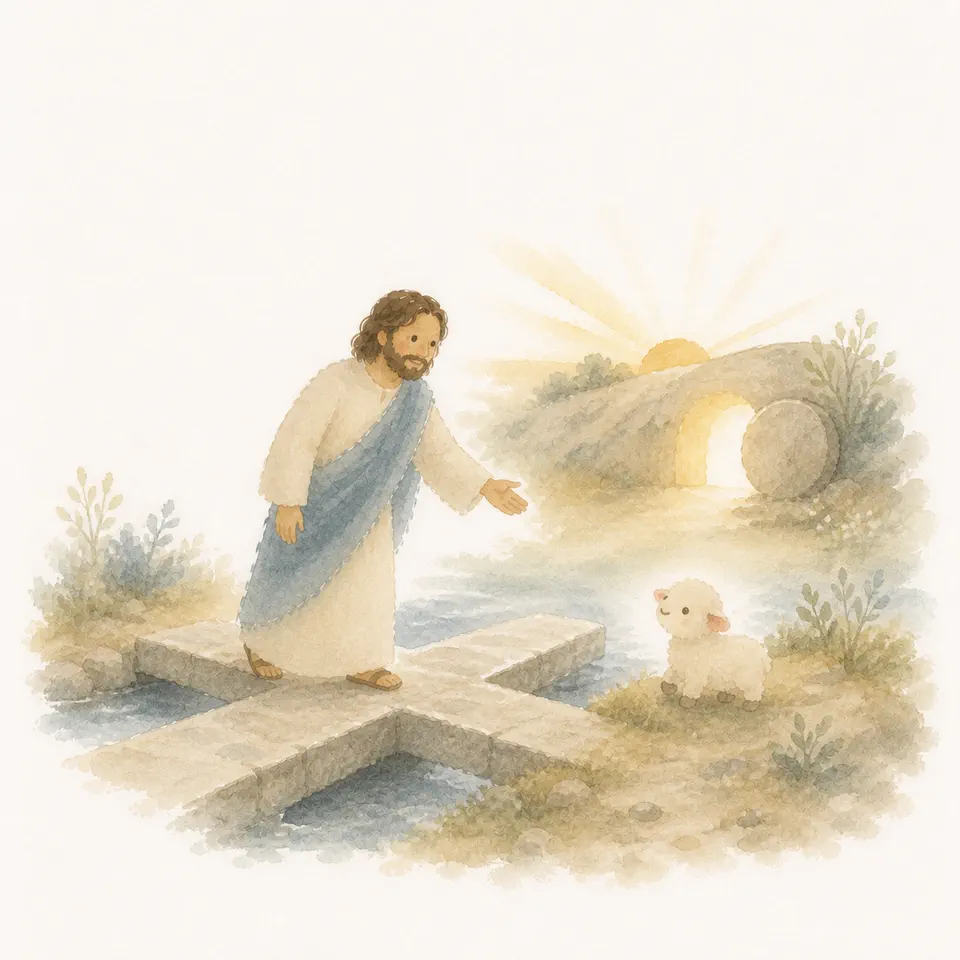
A watercolor of Jesus standing on a stone cross laid like a bridge over water, reaching out a hand to a lamb, with the rolled-away stone and the empty tomb at sunrise behind him
  1. What does the word “Christ” mean?

    Show the answer

    Answer ② It is a title meaning “the anointed one” — the Greek rendering of the Hebrew word “Messiah”

    “Christ” is not a name but a title. Taking it for a surname is the commonest mistake of all, and the one that means “God saves” is the name “Jesus” itself.

    Catechism of the Catholic Church 430, 436

  2. When the early Church called Jesus “Lord,” what was it professing?

    Show the answer

    Answer ② That the name the Old Testament kept for God alone was now given to Jesus — a profession of his divinity

    The Greek Scriptures rendered the name of God as “Kyrios,” the Lord, and the Church gave that very word to Jesus. The fourth leans toward Adoptionism — the idea that Jesus was not God to begin with and only became God later on.

    Catechism of the Catholic Church 446-451

  3. Which of these puts the Church's faith in Jesus Christ most correctly?

    Show the answer

    Answer ① He is true God and true man: two natures united in one person, neither mixed together nor split apart

    This is what the Council of Chalcedon settled. The second makes both the divinity and the humanity into halves that are not whole; the third is Docetism, which leaves the Incarnation as mere appearance; the fourth is Adoptionism. The Church has rejected all three.

    Catechism of the Catholic Church 464-469

  4. If someone says that in Jesus there are “a person who has the divine nature and a person who has the human nature — two persons,” what goes wrong?

    Show the answer

    Answer ② It collapses the truth that the Son of God really became man, leaving the man Jesus and the Word of God as strangers to each other

    The person is one; the natures are two. Say two persons, and you can no longer say that the one who died on the cross is the Son of God — which is exactly the explanation of Nestorius that the Council of Ephesus rejected.

    Catechism of the Catholic Church 466, 468

  5. Once he became man, the humanity of Jesus dissolved into his divinity and disappeared.

    Show the answer

    Answer ② No

    No. Saying that the humanity is swallowed up by the divinity is Monophysitism, which leaves only one nature in Christ. The Church professes two natures, neither mixed nor changed, in the one person. If the humanity vanishes, everything he went through as a man comes to nothing.

    Catechism of the Catholic Church 467, 470

  6. What does the Church say to the claim that Jesus took only a human body and not a human soul and mind?

    Show the answer

    Answer ① He took not only a human body but a rational soul as well, whole and entire

    The Son of God took a human body and a rational human soul together. What is not assumed is not healed, so an incarnation with the soul left out would leave the human heart and mind outside salvation.

    Catechism of the Catholic Church 470-473

  7. In Jesus there is a divine will and a human will, and the human will does not fight the divine will but follows it.

    Show the answer

    Answer ① Yes

    Yes. Since the natures are two, the wills that belong to those natures are two as well. The prayer in Gethsemane — “not my will, Father, but yours be done” — shows that the human will was really there, and that it obeyed.

    Catechism of the Catholic Church 475, 612

  8. Why did the Son of God become man?

    Show the answer

    Answer ① To save us from sin, to show God's love, and to let us share in the life of God

    The Incarnation is God's work of rescuing us from sin, and in it God's love comes to light and we come to share in the divine nature. The second makes God someone who did not already know what human life is; the third shrinks Jesus into no more than a fine teacher; the fourth turns salvation into a patch over a botched creation.

    Catechism of the Catholic Church 456-460

  9. What does the Church profess about the conception of Jesus?

    Show the answer

    Answer ② He was conceived by the Holy Spirit, of the Virgin Mary

    The conception of Jesus was not the work of human power but of the Holy Spirit, and it shows that he is truly the Son of God. The fourth is an old misunderstanding that treats Mary as a channel and nothing more — and then Jesus would not have taken flesh like ours.

    Catechism of the Catholic Church 484-486, 496-498

  10. Why does the Church call Mary “the Mother of God”?

    Show the answer

    Answer ③ Because the one she bore is the Son of God made man — that very person

    A mother does not give birth to a nature; she gives birth to a person. The one Mary bore is the person who is the Son of God, so this title guards who Jesus is even more than it says something about Mary. The fourth is the explanation the Council of Ephesus rejected.

    Catechism of the Catholic Church 466, 495

  11. The “brothers of Jesus” in the Gospels are other children born to Mary.

    Show the answer

    Answer ② No

    No. In the language of Scripture “brother” stretches as far as close relatives, and elsewhere these same people are named as relatives of Jesus. The Church has professed without wavering that Mary is Ever-Virgin.

    Catechism of the Catholic Church 499-501

  12. What does the Church say about the hidden life at Nazareth, before the public ministry began?

    Show the answer

    Answer ③ His whole life is revelation and salvation, so the hidden years too are a mystery for our sake

    Everything Jesus did and everything he underwent is a mystery of salvation. Treating the cross alone as the saving part and the rest as background is a common way of shrinking it — the obedience, the work, and the ordinary days were lived for us too.

    Catechism of the Catholic Church 512-517, 531-534

  13. Jesus had no sin of his own; what, then, does his baptism in the Jordan reveal?

    Show the answer

    Answer ② That he takes his stand among sinners of his own accord, in our place, and that the Father declares him the beloved Son

    Jesus had no sin to repent of, yet he put himself where the sinners stood, and at that moment the voice of the Father and the descent of the Holy Spirit show who he is. The fourth is Adoptionism — the idea that he was “adopted” as Son right there.

    Catechism of the Catholic Church 535-537

  14. What were the miracles of Jesus for?

    Show the answer

    Answer ③ To announce that the kingdom of God has already come in him, and to draw people to believe in him

    A miracle is neither a spectacle nor a lever for forcing anyone; it is a sign that the kingdom of God has drawn near. Jesus refused to perform signs for those out to test him, and people who saw miracles with their own eyes could still go on not believing.

    Catechism of the Catholic Church 547-550

  15. Responsibility for the passion of Jesus can be laid on the Jewish people of that time as a whole, or on Jews today.

    Show the answer

    Answer ② No

    No. The Church has rejected this idea in plain words. It is sinners of every age who nailed Christ to the cross, and Christians who keep sinning while saying they belong to him carry that responsibility more heavily still.

    Catechism of the Catholic Church 597-598

  16. Which is the truest way of understanding the death of Jesus on the cross?

    Show the answer

    Answer ④ His own life laid down freely, in loving obedience to the Father, to rescue us from sin

    The cross is not a punishment forced upon him but a love freely given. The first is the common misunderstanding that makes the Father out to be someone eager to punish — when the one who loved us first and gave us his Son is the Father himself.

    Catechism of the Catholic Church 606-609, 613-616

  17. What does the line of the Creed “he descended to the dead” mean?

    Show the answer

    Answer ④ That he truly died, went as far as the place of the dead, and opened salvation to the righteous who had gone before him

    The death of Jesus was a real death and not an appearance, and he carried salvation as far as the world of the dead. Read that descent as a sentence being served in hell, as the first does, and the mystery is turned upside down.

    Catechism of the Catholic Church 632-635

  18. How is the resurrection of Jesus different from the raising of Lazarus?

    Show the answer

    Answer ④ He did not come back to a life that must die again; he crossed beyond death into a glorified body

    Lazarus had to die again later on, but the risen Christ dies no more. The second makes the resurrection a matter of the soul alone; the third turns it into the memory of the disciples, which explains neither the empty tomb nor the appearances.

    Catechism of the Catholic Church 645-647

  19. The resurrection left traces in history that can be checked, such as the empty tomb and the appearances, and yet the event itself cannot be fully contained by the measures of history.

    Show the answer

    Answer ① Yes

    Yes. The resurrection is not a story someone made up but a real event that left witnesses and traces behind. Still, the crossing beyond death itself was seen by no one, so it is an event inside history that also goes past history.

    Catechism of the Catholic Church 639-647

  20. What does the profession “he is seated at the right hand of God, and will come to judge the living and the dead” mean?

    Show the answer

    Answer ④ That as man too he shares in the glory of God and reigns, and that at the end of history he will come again in glory

    “The right hand” is not a seat somewhere; it is a way of speaking of the glory and the reign of God. The second mistakes the Ascension for an absence, when he is always with us in the Holy Spirit and in the sacraments; the third runs against the words that no one knows that day or that hour.

    Catechism of the Catholic Church 659-664, 673