0 / 8 answered

Kept in this browser alone

Liturgy — what we celebrate

Holy Orders

Choose an option and you are told at once whether it was right. The answer and the reason wait behind “Show the answer”.
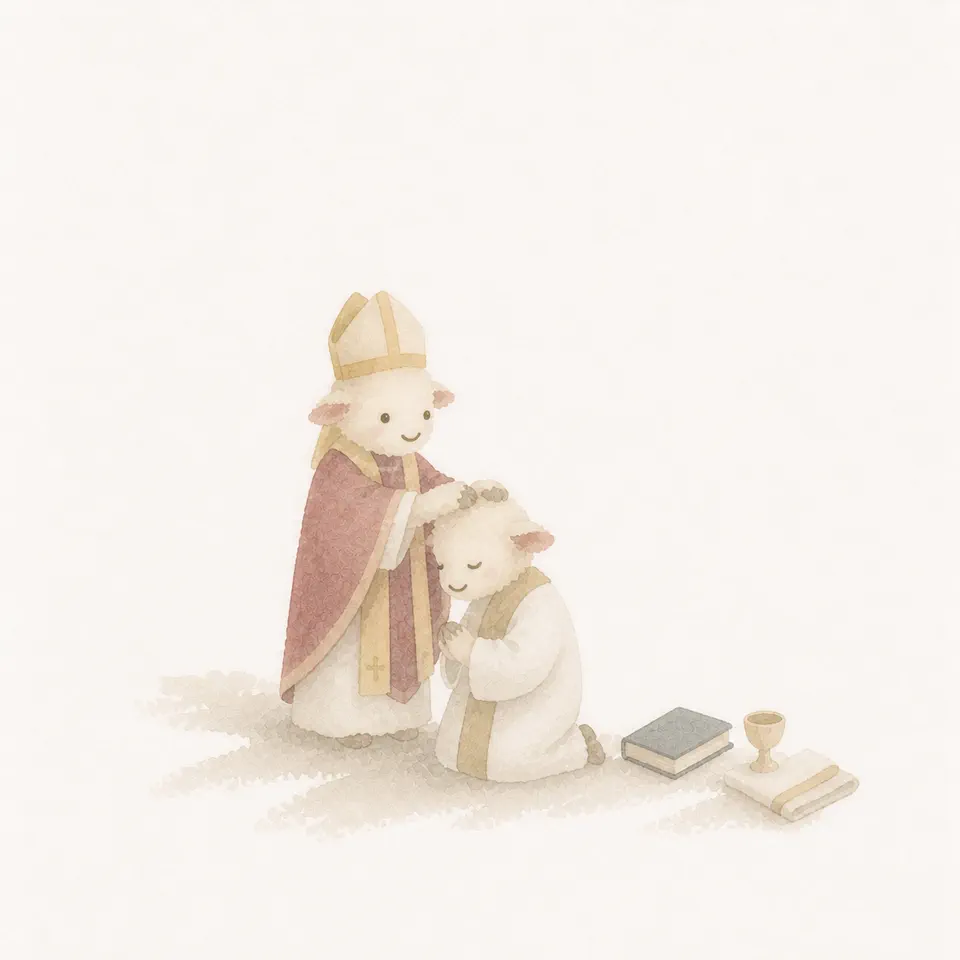
A watercolor of a lamb bishop laying both hands on the head of a kneeling lamb, with a closed book, a gold chalice, and a folded white cloth set on the ground beside them
  1. Which of these names the three degrees of Holy Orders correctly?

    Show the answer

    Answer ③ Bishops, priests and deacons

    Holy Orders is made up of three degrees — the episcopate, the presbyterate and the diaconate — and its fullness is found in the episcopate. The Pope is not a fourth degree standing apart from these; he is the bishop of the Church of Rome. Religious life is not a degree of Holy Orders at all but a form of consecrated life, and an office held by a lay person is something else altogether.

    Catechism of the Catholic Church 1536, 1554

  2. What is the relation between the “common priesthood” received in baptism and the “ministerial priesthood” received in Holy Orders?

    Show the answer

    Answer ④ They are ordered to one another, yet they differ in essence and not only in degree

    Both share in the one priesthood of Christ, but the manner of sharing is itself different. Read it as the first choice does, as a difference of degree only, and ordination becomes nothing more than a baptism with a larger share of the same thing; the second and third each rub one side out, losing either the priesthood of the baptized or the ministry proper to the ordained.

    Catechism of the Catholic Church 1546-1547

  3. Holy Orders imprints an indelible character, and so it cannot be received a second time.

    Show the answer

    Answer ① Yes

    Yes. Like Baptism and Confirmation, ordination marks the soul with an indelible character, so it can be received neither twice nor for a limited time only. A man may be forbidden to exercise his ministry, or released from its obligations, but that does not cancel the ordination and make him a layman again in the strict sense.

    Catechism of the Catholic Church 1582-1583

  4. If a priest is living in sin, the sacraments he celebrates lose their effect.

    Show the answer

    Answer ② No

    No. The power of a sacrament comes from Christ, not from the holiness of the minister. Follow this mistake to the end and the validity of the sacraments hangs on the person of the priest — which is the error of Donatism, and the Church rejected it long ago.

    Catechism of the Catholic Church 1128, 1584

  5. What is the essential rite by which Holy Orders is conferred?

    Show the answer

    Answer ② The bishop's laying on of hands, followed by the prayer of consecration

    Holy Orders is conferred when the bishop lays his hands on the candidate in silence and then says the prayer of consecration over him. Handing over the chalice and anointing the hands are explanatory rites that make the meaning visible to the eye; they are not the part that makes the sacrament.

    Catechism of the Catholic Church 1573

  6. Who can validly confer Holy Orders?

    Show the answer

    Answer ① A validly ordained bishop

    Only a bishop, as a successor of the apostles, can confer all three degrees. Neither a priest nor a religious superior can ordain, however long he has held his office, and the power is not reserved to the Pope alone — every bishop ordains within the apostolic succession.

    Catechism of the Catholic Church 1576

  7. Which of these is true of the diaconate?

    Show the answer

    Answer ④ Hands are laid on a deacon not for the priesthood but for a ministry of service

    A deacon has hands laid on him “not unto the priesthood, but unto the ministry”, and this is one of the degrees of Holy Orders. Because some men do pass through the diaconate on the way to priestly ordination, the first choice is an easy mistake to make; but the permanent diaconate shows that the diaconate is a whole degree in itself, and saying the Eucharistic Prayer is no part of a deacon's office.

    Catechism of the Catholic Church 1569-1571

  8. When a priest says “This is my body” at Mass, in whose place is he speaking?

    Show the answer

    Answer ① In the place of Christ the Head, and in Christ's name

    The ordained man acts in the person of Christ the Head — in persona Christi Capitis — and it is for that very reason that a priest can also pray in the name of the whole Church. Take the second choice, that his authority rises out of a mandate from the assembly, and ordination becomes an elected office; the third turns the sacrament into a piece of theatre.

    Catechism of the Catholic Church 1548, 1552