0 / 10 answered

Kept in this browser alone

Liturgy — what we celebrate

Baptism

Choose an option and you are told at once whether it was right. The answer and the reason wait behind “Show the answer”.
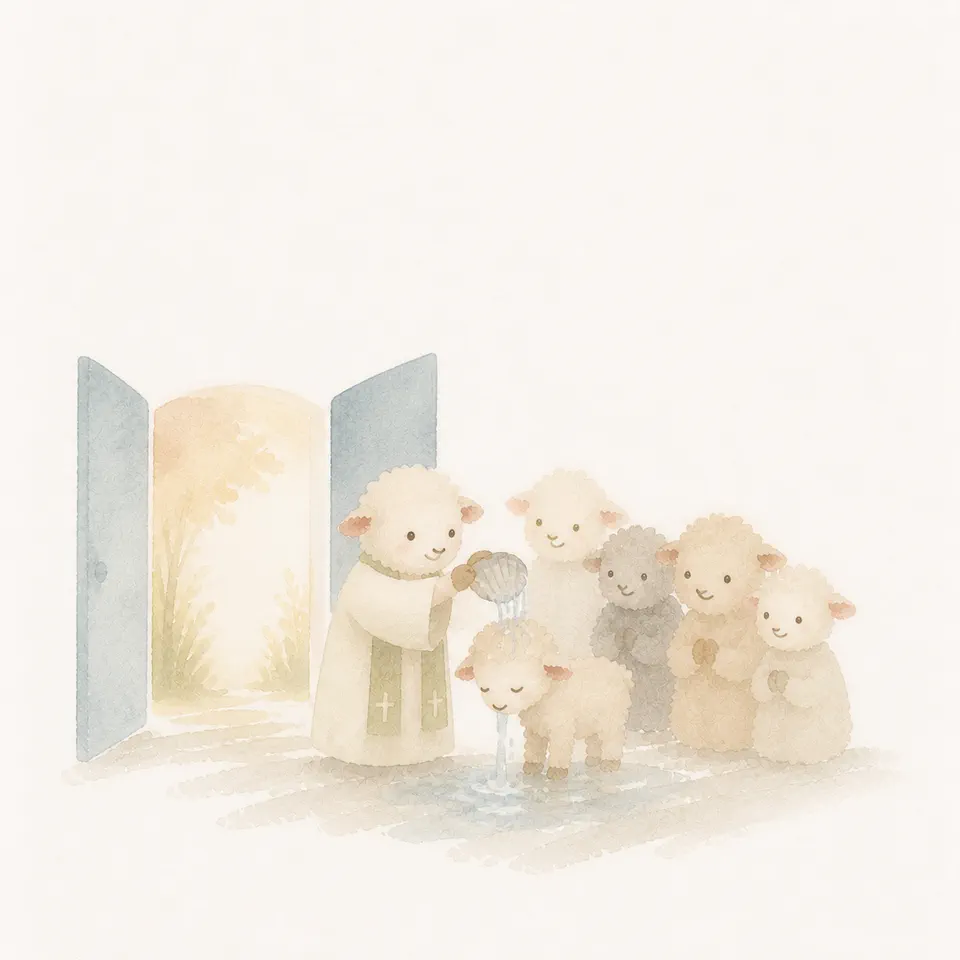
A watercolor of a priest lamb pouring water from a shell over a bowed little lamb beside a wide open door, with several lambs looking on
  1. Why is Baptism called “the door of the Christian life”?

    Show the answer

    Answer ③ Because in it we are born again into new life in the Holy Spirit, and it opens onto the other sacraments

    Baptism is not an administrative step, and it is not a ceremony confirming something handed down. It is being born anew. It is called a door because only by passing through it can anyone go on to the other sacraments.

    Catechism of the Catholic Church 1213

  2. What is the essential rite of Baptism?

    Show the answer

    Answer ① Immersion in water, or the pouring of water on the head, with the words “I baptize you in the name of the Father, and of the Son, and of the Holy Spirit”

    Water and the Trinitarian formula have to be there together, or it is not a baptism. The second answer is a form cut loose from faith in the Trinity, the third is the rite of Confirmation, and the fourth turns a sacrament into a decision taken inwardly.

    Catechism of the Catholic Church 1239-1240, 1278

  3. In danger of death, even a person who is not baptized may baptize, provided they keep the Trinitarian formula and intend to do what the Church does.

    Show the answer

    Answer ① Yes

    The ordinary ministers of Baptism are the bishop, the priest and the deacon, but in danger of death anyone at all may baptize. Baptism matters so much that the Church has opened the door wide. Water, the Trinitarian formula and the intention of doing what the Church does must all be there.

    Catechism of the Catholic Church 1256, 1284

  4. It later comes to light that the person who administered a baptism was guilty of grave sin. What is the right thing to say about that baptism?

    Show the answer

    Answer ③ Since it is Christ who acts in the sacraments, that baptism stands as valid

    Holding that the power of a sacrament rests on the holiness of the minister was the error of Donatism, and the Church rejected it. A minister's sin cannot bring down Christ's promise. What the minister does have to bring is the intention of doing what the Church does.

    Catechism of the Catholic Church 1127-1128

  5. Which answer states correctly what Baptism washes away and what it leaves behind?

    Show the answer

    Answer ② It removes every sin and the punishment due to them, but the inclination to sin remains

    Baptism washes away original sin, every personal sin committed up to that moment, and the punishment due to them as well. What remains is the inclination to sin, called concupiscence, and the baptized are called to struggle with it all their lives. Believe the third answer and you will watch yourself fall after Baptism and conclude that your baptism came to nothing.

    Catechism of the Catholic Church 1263-1264

  6. Why does the Church baptize infants as well?

    Show the answer

    Answer ④ Because salvation is a gift given freely and never earned, and in the faith of the Church and of the parents the child is entrusted to Christ

    The common objection to infant baptism is that it is “a faith the person never chose”. But grace is not something anyone earns; it is received for nothing, and a baby too is born bearing original sin. The second answer is an explanation with original sin rubbed out. Parents and godparents take on together the duty of helping that faith to grow.

    Catechism of the Catholic Church 1250-1252, 1282

  7. Someone baptized as an infant has to be baptized again as an adult, when they profess the faith for themselves.

    Show the answer

    Answer ② No

    Baptism marks an indelible character, so it cannot be repeated — not for someone who has sinned, and not for someone who left the faith for a time. What adult believers do is not a second baptism but the renewal of their baptismal promises, and the sacrament that strengthens that faith is Confirmation.

    Catechism of the Catholic Church 1272, 1280

  8. Someone baptized in another Christian communion with water, in the name of the Father and of the Son and of the Holy Spirit, comes into the Catholic Church. What does the Church do?

    Show the answer

    Answer ① She accepts that baptism as valid and does not baptize the person again

    A baptism rightly celebrated with water and the Trinitarian formula is valid whichever Christian communion it was received in, and that is why Baptism is the bond of unity that ties separated Christians to one another. To baptize again would be to doubt what Christ has already done.

    Catechism of the Catholic Church 1271, 1272

  9. What does the Church teach about someone who dies without having been baptized?

    Show the answer

    Answer ④ God has bound salvation to Baptism, but he himself is not bound by his sacraments; so the Church acknowledges baptism of blood and baptism of desire, and entrusts the rest to his mercy

    The first answer shuts God's mercy inside a fence people built, and the second rubs out the necessity of Baptism. The Church teaches Baptism as the way of salvation and confesses at the same time that God is not locked inside the sacraments he established. Infants who die without Baptism are entrusted to his mercy too.

    Catechism of the Catholic Church 1257-1261

  10. Why is Baptism never merely one person's private affair?

    Show the answer

    Answer ② Because through it we become members of the Church, the body of Christ, and share in the common priesthood

    Baptism is not a private arrangement I make with God on my own. Through it we are joined to the body of Christ as its members, and we come to share in the priestly, prophetic and kingly office that all the faithful hold together. The third and the fourth answers mistake something attached to the ceremony for what Baptism actually means.

    Catechism of the Catholic Church 1267-1270