0 / 14 answered

Kept in this browser alone

Life — what we live

Commandments 1–3 · Loving God

Choose an option and you are told at once whether it was right. The answer and the reason wait behind “Show the answer”.
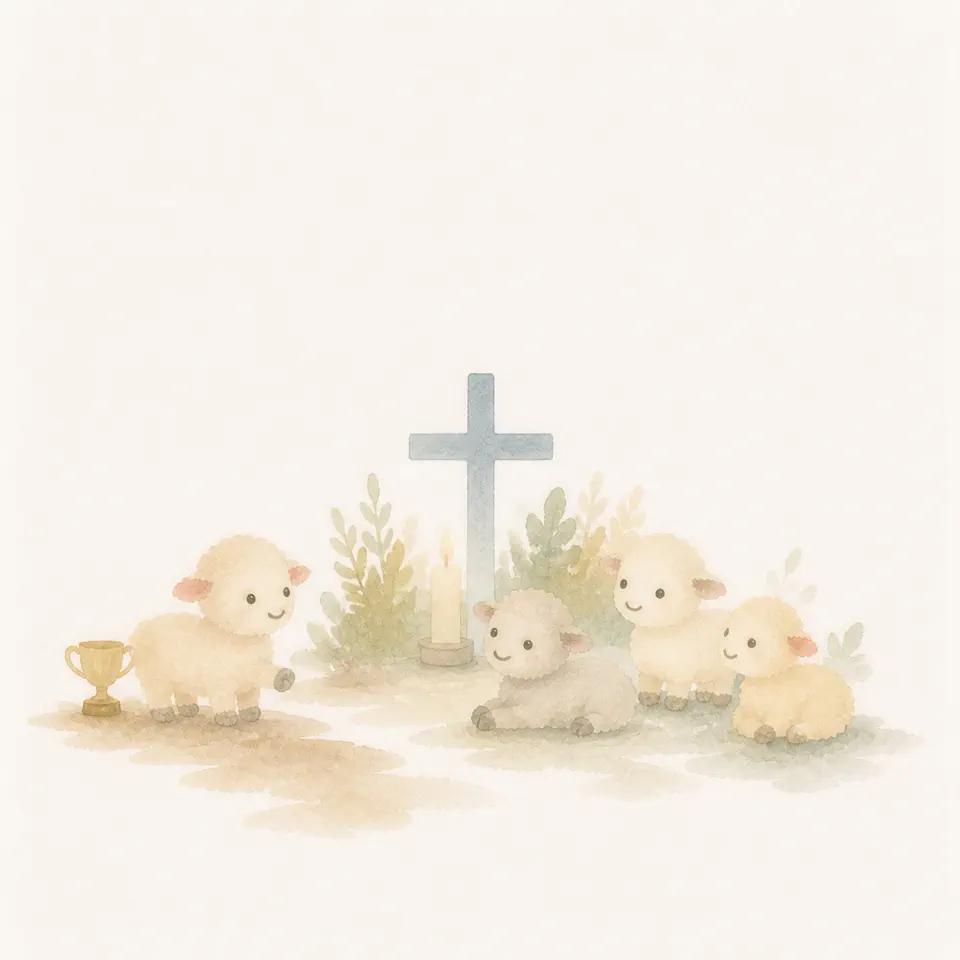
A watercolor of a lamb leaving a golden trophy cup on dry ground and walking toward a lit candle at the foot of a cross where three lambs are gathered
  1. What is it that divides the first three commandments from the other seven?

    Show the answer

    Answer ④ The first three are the way of loving God, the last seven the way of loving your neighbor

    The old picture of the two stone tablets holds exactly this division. Split them by how hard they are to keep, or by which Testament they came in, and you lose the point that the whole of the Ten is gathered up into the two commandments of love; and dividing them into heart and body is a misreading as well, cutting every commandment into an inside and an outside.

    Catechism of the Catholic Church 2067, 2083

  2. What does the first commandment require of us?

    Show the answer

    Answer ① To believe in God, to hope in him and to love him, and to adore him alone

    It is easy to read the first commandment as nothing but a prohibition, but what lies inside it is a positive call to live by faith, hope and charity. The second and the fourth narrow the commandment down to a single line against idols, and the third mistakes it for a warrant to sit in judgment on other people.

    Catechism of the Catholic Church 2084-2086, 2093

  3. To bow before a statue or an icon and venerate it is the idolatry that the first commandment forbids.

    Show the answer

    Answer ② No

    Veneration does not stop at the image; it passes across to the one the image points to. Idolatry means seating a creature in God's own place, and so the adoration given to God alone and the veneration given to the saints differ in kind, not merely in degree.

    Catechism of the Catholic Church 2131-2132

  4. Why do we say that idolatry still goes on today?

    Show the answer

    Answer ④ Because putting something that is not God — money, power, pleasure — in the place of the absolute is itself idolatry

    Idolatry is not a question of what an object is made of but of what the heart sets in the highest place. Narrow it down to the carving of images and you will never notice the idol that actually governs your own life; stretch it far enough to condemn someone for watching another community's ceremony and the commandment loses the target it was aimed at.

    Catechism of the Catholic Church 2112-2114

  5. Why does the Church reject recourse to divination, horoscopes and spiritism?

    Show the answer

    Answer ③ Because they hand the future over to some power other than the hand of God, and carry in them the wish to bend people and events by a hidden force

    The trouble is neither how often such things come true nor whether they are in fashion; it is the direction the heart is facing. Handing to another power the trust and obedience owed to God, and wanting to steer other people by that power, is the root of superstition, divination and magic.

    Catechism of the Catholic Church 2115-2117

  6. The Church confesses plainly where the true religion is to be found, and at the same time defends religious freedom. Why?

    Show the answer

    Answer ② Because faith cannot be forced, and a person must freely seek the truth and freely hold to it

    Religious freedom is not a conclusion drawn from the relativism that makes every religion the same. Truth reaches the conscience by its own force, so a belief planted by pressure was never belief in the first place.

    Catechism of the Catholic Church 2104-2106

  7. Atheism too is counted among the sins against the first commandment.

    Show the answer

    Answer ① Yes

    Yes. How much of it any given person is answerable for, though, varies a great deal with the circumstances of a life. And the Catechism says in the same breath that believers whose own lives contradict their faith have often had a hand in hiding the face of God.

    Catechism of the Catholic Church 2123-2126

  8. What is it that the second commandment tells us to keep?

    Show the answer

    Answer ② Holding the name of God holy — never using it carelessly, never dishonoring it

    This is not a commandment forbidding us to speak the name; it is one telling us to hold the name in reverence. The name of God is to be spoken in praise, in prayer and in blessing, and never made a tool of anger, of cursing or of an empty oath.

    Catechism of the Catholic Church 2142-2144, 2146

  9. Why does swearing a false oath on the name of God weigh so heavily?

    Show the answer

    Answer ① Because it drags God, who is truth itself, in as a witness to a lie

    What makes perjury grave is not the risk of being found out, nor the penalty that follows. It amounts to asking the one who is Truth to stand surety for a falsehood. An oath in itself is permitted where there is a proper reason for it; what is forbidden is swearing lightly, over anything and nothing.

    Catechism of the Catholic Church 2150-2152, 2155

  10. Why is the name received at baptism spoken of alongside the second commandment?

    Show the answer

    Answer ③ Because God calls each person by name, and that name is to be held holy

    God does not gather people into an anonymous crowd; he calls them by name, and the name given at baptism keeps that call in mind. A saint's name is not a channel down which power travels but an example to follow and an intercessor to lean on, and nothing in it says the old name was unclean and must be discarded.

    Catechism of the Catholic Church 2156-2159

  11. Christians keep Sunday in place of the sabbath because that is the day the Lord rose.

    Show the answer

    Answer ① Yes

    Yes. Sunday did not push the sabbath aside; it fulfils what the sabbath always meant. The creation that began on the first day of the week and the new creation made in the resurrection fall together on that one day, and so it became “the Lord's Day”.

    Catechism of the Catholic Church 2174-2176

  12. What does the Church teach about taking part in Mass on Sundays and holy days of obligation?

    Show the answer

    Answer ④ To miss it without a serious reason is a grave sin

    Where there is a serious reason — illness, or care of someone who cannot be left — the obligation does not bind, and anyone in that position is encouraged to follow the Liturgy of the Word or to offer prayer alone or with the family. But “the heart is enough”, or a broadcast standing in week after week, erases the fact that Sunday Mass is the work of a community that gathers in one place and shares the one Eucharist.

    Catechism of the Catholic Church 2180-2181, 2183

  13. What does the teaching that we should rest from work on Sunday most truly mean?

    Show the answer

    Answer ① It keeps room open for worshipping God, for the care of family and the poor, and for breathing as a human being should

    Sunday rest is not a state of doing nothing; it is space cleared for something. Necessary service and care carry on through Sunday too, and what the Church warns against is binding people to endless work out of habit or for profit.

    Catechism of the Catholic Church 2184-2186

  14. Keeping Sunday is a matter of personal devotion and nothing more; it has no bearing on the social conditions that let other people rest.

    Show the answer

    Answer ② No

    The Church asks the faithful to work for public conditions in which the rest of Sunday reaches everyone. Taking another person's labor for granted while enjoying a Sunday of your own erases the social face that the third commandment has always had.

    Catechism of the Catholic Church 2187-2188