Death, dying, and funerals · Question 10
Can cremated remains be scattered at sea, or divided up to keep at home and in jewelry?
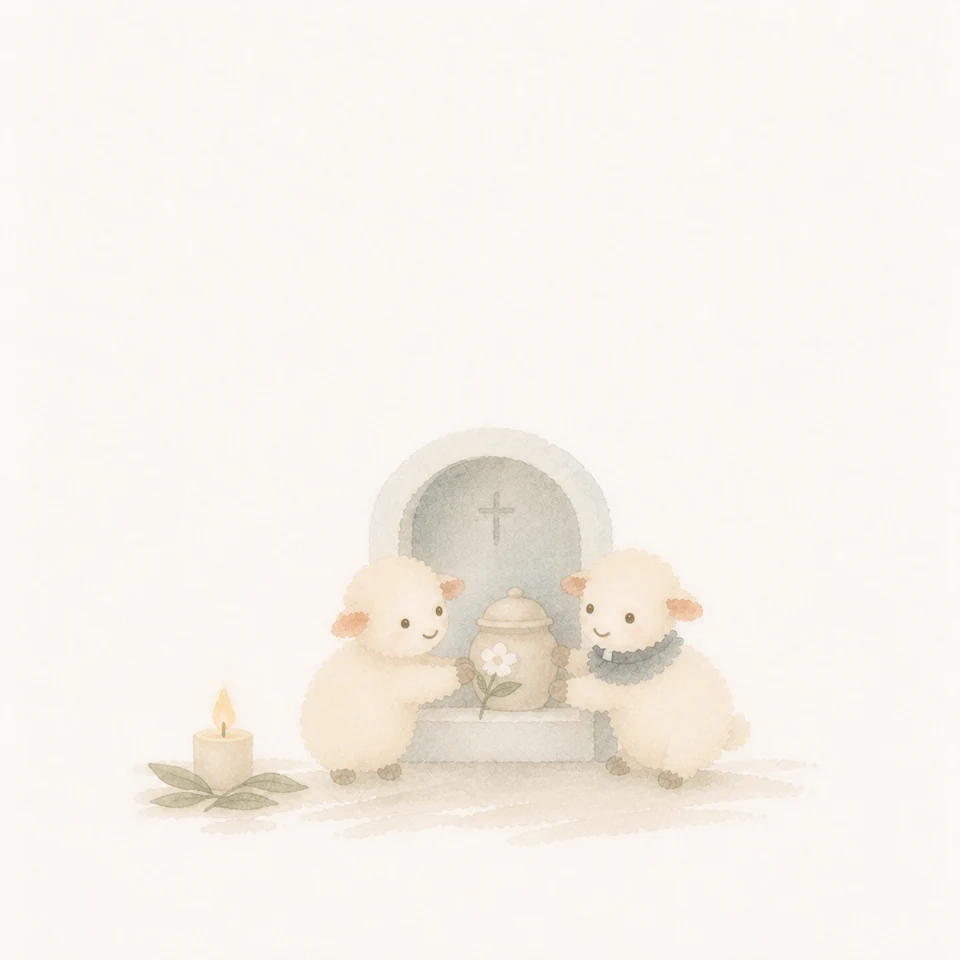
The question: “Wouldn't scattering them on the mountain they loved, or each of us carrying a little in a necklace, keep the memory closer?”
The Church's answer: The Church asks that cremated remains be laid in a sacred place fit for prayer — a cemetery, or a place church authority has designated for that purpose. That way the name and the memory of the one who died are kept for the generations that follow, the whole church community and not the family alone goes on praying, and the remains are guarded from being forgotten, damaged, or put to superstitious use. So scattering remains in the air, on land, or at sea, and placing them in jewelry or keepsakes, is not permitted. As a general rule, keeping them at home or dividing them among several family members is not permitted either.
A 2023 reply from the Dicastery for the Doctrine of the Faith confirmed that the 2016 instruction still holds, and explained two further points. Where the competent church authority establishes it and keeps a record so that no individual name is lost, a fixed sacred place may be set up in which the remains of the baptized are kept together. And on the condition that the greater part of the remains stays in a sacred place, that any pantheistic, naturalistic, or nihilistic misunderstanding is ruled out, that civil law is observed, and that the competent church authority has assessed the individual request, it is possible for a very small portion to be fittingly preserved in a place meaningful to the life of the one who died. This is not a general permission for a family to divide the remains on its own and keep them at home or in jewelry.
If they press further: “If we already keep them at home, or have already scattered them, it can't be undone — so are we just left with guilt?” — don't start with blame; explain the situation honestly to your parish or your diocese. Together you can look for a pastoral way, one that fits local civil law and the Church's guidance, to lay whatever remains there are in a sacred place with dignity and within the law.
In one sentence: “As a rule, remains are laid in a sacred place such as a cemetery, and not scattered or divided into jewelry. Even the very limited exception opened in 2023 needs a case-by-case assessment by the competent church authority, and it isn't permission for a family to keep them as it pleases.”