0 / 10 answered

Kept in this browser alone

Liturgy — what we celebrate

What the liturgy is

Choose an option and you are told at once whether it was right. The answer and the reason wait behind “Show the answer”.
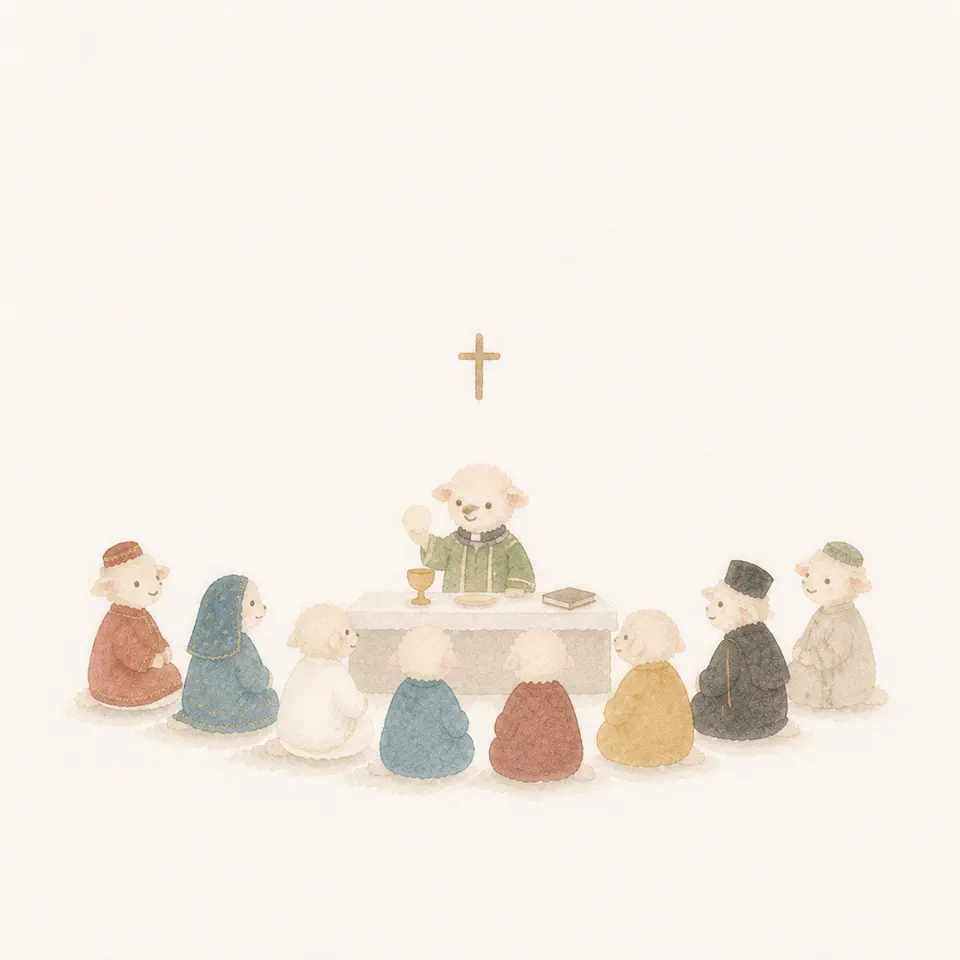
A watercolor of a lamb priest in a green chasuble raising the host behind an altar set with a chalice and a book, with lambs in colorful robes seated around it
  1. What did the word “liturgy” mean to begin with?

    Show the answer

    Answer ③ A public work for the people, taken on and carried out by the people together

    The word comes from Greek, where it meant “a public work the people take on and carry out together,” and the Church filled it with the sense that God's people share in the work of God. The first and the fourth shrink the liturgy down to private prayer or to rules that hold good only inside a building, and the second mistakes the liturgical books for the liturgy itself.

    Catechism of the Catholic Church 1069-1070

  2. Who is it that truly celebrates the Mass and the rest of the liturgy?

    Show the answer

    Answer ① Christ the high priest, together with the whole Church, which is his body

    The liturgy is where the priesthood of Christ is exercised: it is the whole public worship offered by Christ the head together with the faithful who are his members. The second turns the assembly into spectators, and the third lowers the liturgy into an event that people put together themselves.

    Catechism of the Catholic Church 1069-1071, 1140

  3. The liturgy takes in everything the Church does, with nothing left over.

    Show the answer

    Answer ② No

    The liturgy is the summit and the source of the Church's activity, but it is not the whole of it. Before the liturgy there must be the proclamation of the Gospel, faith, and conversion; and the strength drawn from the liturgy has to carry on into works of love.

    Catechism of the Catholic Church 1072, 1074

  4. What does it mean to say “the liturgy is the summit of the Church's activity and at the same time its source”?

    Show the answer

    Answer ④ That all the Church's activity moves toward the liturgy, and also draws its strength there and flows out from it

    A summit is what everything climbs toward; a source is what everything flows out from. The first uses the liturgy as an excuse for erasing works of love, while the third blurs it in the opposite direction, into one event among many.

    Catechism of the Catholic Church 1074

  5. Which of these says most correctly how Christ is present in a liturgical celebration?

    Show the answer

    Answer ② He is present in several ways at once — in the priest who celebrates, in the Eucharist, in the word proclaimed, and in the assembly at prayer

    Christ is present in the Eucharist in a singular way, and he is present too in his word, in the person of the minister who celebrates, and in the assembly that prays and sings. The first narrows that presence to a single place, and the third and the fourth swap the liturgy for human recollection or human feeling.

    Catechism of the Catholic Church 1088

  6. In the liturgy, keeping the “memorial” of the Paschal Mystery of Christ means calling a past event to mind and dwelling on it.

    Show the answer

    Answer ② No

    The memorial of the liturgy does not stop at recalling something long ago: in the power of the Holy Spirit the Paschal Mystery of Christ is made present here today. The sacrifice of the cross is not repeated, and yet its grace reaches us now.

    Catechism of the Catholic Church 1085, 1104

  7. Which is the most accurate description of a sacrament?

    Show the answer

    Answer ① A sign instituted by Christ and entrusted to the Church, which really brings about the grace it signifies

    A sacrament is a sign, and at the same time it really brings about the grace that the sign points to. The second leaves the sacrament as no more than a symbol, and the fourth erases the fact that it was Christ who instituted it.

    Catechism of the Catholic Church 1113, 1131

  8. Why does the effect of a sacrament not depend on the personal holiness of the priest who celebrates it?

    Show the answer

    Answer ④ Because the one at work in the sacrament is Christ himself

    A sacrament is brought about by the power of Christ and not by human merit — the Church calls this ex opere operato — so the sacrament is true even when the minister himself falls short. The fruit of a sacrament does vary with the disposition of the one receiving it, which is why the third goes too far in making that disposition decide everything.

    Catechism of the Catholic Church 1127-1128

  9. Sunday is the foremost of all the feast days the Church keeps.

    Show the answer

    Answer ① Yes

    Sunday is the day the Lord rose, so it is the original feast day and the ground of every other one. It is not that the sabbath was simply shifted by a day to give us a day off; it is because of the resurrection that the first day of the week became the Lord's Day.

    Catechism of the Catholic Church 1166-1167

  10. Besides the Latin rite there are other liturgical rites in the Church, the Byzantine among them. How should we see that?

    Show the answer

    Answer ③ The one mystery of Christ showing itself within many cultures, a legitimate richness

    The Church recognizes the rites in use today as holding equal dignity and equal rights, and sees that variety as bringing out the richness of one and the same mystery. It is not the second, though: each rite is a living tradition handed down and received, and the authority of the Church safeguards it.

    Catechism of the Catholic Church 1200-1203