0 / 8 answered

Kept in this browser alone

Liturgy — what we celebrate

Confirmation

Choose an option and you are told at once whether it was right. The answer and the reason wait behind “Show the answer”.
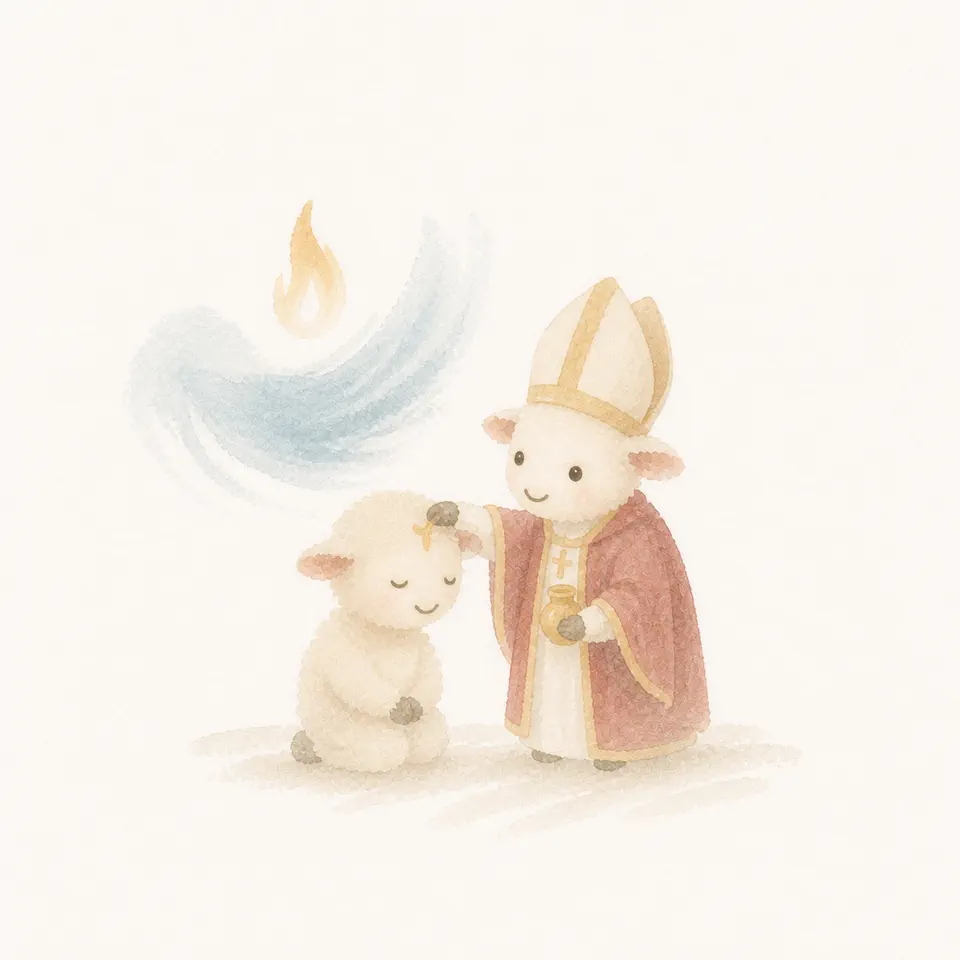
A watercolor of a lamb bishop in a miter and red robe holding a vessel of holy oil and tracing a cross on the forehead of a kneeling lamb, with a flame and a blue swirl of wind above
  1. Which three are the sacraments of Christian initiation?

    Show the answer

    Answer ① Baptism · Confirmation · the Eucharist

    The sacraments of initiation are Baptism, Confirmation and the Eucharist. Because of the custom of preparing for confession ahead of First Communion, Penance often gets counted in among them by mistake — but Penance is a sacrament of healing, one that raises up again someone who has already been initiated.

    Catechism of the Catholic Church 1212, 1285

  2. Which gesture from the age of the apostles does Confirmation carry on?

    Show the answer

    Answer ④ The apostles laying hands on those already baptized so that they received the Holy Spirit

    Acts tells how, at Samaria, the apostles laid their hands on people who had already been baptized and the Holy Spirit came down on them. The first three were things the apostles did as well, but each is a different strand, running on into the Anointing of the Sick, the Eucharist and the appointing of ministers.

    Catechism of the Catholic Church 1288, 1315

  3. In the Latin Church, what is the essential rite of Confirmation?

    Show the answer

    Answer ② The anointing of the forehead with sacred chrism, together with the laying on of the hand and the words “Be sealed with the Gift of the Holy Spirit”

    The anointing with chrism, the laying on of the hand and the words “Be sealed with the Gift of the Holy Spirit” make up the essential rite together. The light blow on the cheek was a secondary gesture attached to the older rite, and the confirmation name and the candle are customs that help the celebration along — they do not constitute the sacrament.

    Catechism of the Catholic Church 1300, 1320

  4. Which of these states the grace of Confirmation most accurately?

    Show the answer

    Answer ③ It completes the grace of Baptism, so that in the strength of the Holy Spirit we bear witness to the faith and defend it

    Confirmation deepens the grace of Baptism, sends the confirmed out as witnesses of Christ and binds them more firmly to the Church. The first answer forgets that the Holy Spirit was already received at Baptism, and the fourth confuses Confirmation with Holy Orders.

    Catechism of the Catholic Church 1302-1303, 1316

  5. Confirmation imprints an indelible character, and so it is received only once in a lifetime.

    Show the answer

    Answer ① Yes

    Like Baptism and Holy Orders, Confirmation marks the soul with a character and is therefore never repeated. Someone whose faith went cold and who has come back does not receive Confirmation a second time; the grace of it is brought back to life through the sacrament of Penance.

    Catechism of the Catholic Church 1304, 1317

  6. In the Latin Church, who gives Confirmation?

    Show the answer

    Answer ④ The bishop is the ordinary minister, and in the cases laid down in canon law a priest may give it too

    The ordinary minister of Confirmation is the bishop, but a priest confirms as well when he baptizes an adult, or when someone is in danger of death. The first answer — “only a bishop, no exceptions” — closes off a way the Church has deliberately left open, and a deacon is never the minister of this sacrament.

    Catechism of the Catholic Church 1312-1314

  7. What does the sacred chrism used at Confirmation most truly signify?

    Show the answer

    Answer ① That we share in Christ, the Anointed One, and receive the seal of the Holy Spirit

    The names “Christ” and “Christian” themselves come from anointing, and the anointing at Confirmation draws us into that anointing and sets the seal of the Holy Spirit on us. Oil for the healing of illness belongs to the Anointing of the Sick, and oil for the entrusting of an office belongs to Holy Orders, which is why the three are so easily mixed up.

    Catechism of the Catholic Church 1289, 1293-1296

  8. Confirmation is the sacrament of “adult faith”, so it can only be received once a person has grown up and become mature.

    Show the answer

    Answer ② No

    Confirmation is sometimes called the sacrament of “Christian maturity”, but maturity of faith and maturity in natural age are not the same thing. In the Eastern Churches a newly baptized infant is confirmed straight away, and a child in danger of death receives it whatever their age.

    Catechism of the Catholic Church 1307-1308, 1318