0 / 6 answered

Kept in this browser alone

Liturgy — what we celebrate

Anointing of the Sick

Choose an option and you are told at once whether it was right. The answer and the reason wait behind “Show the answer”.
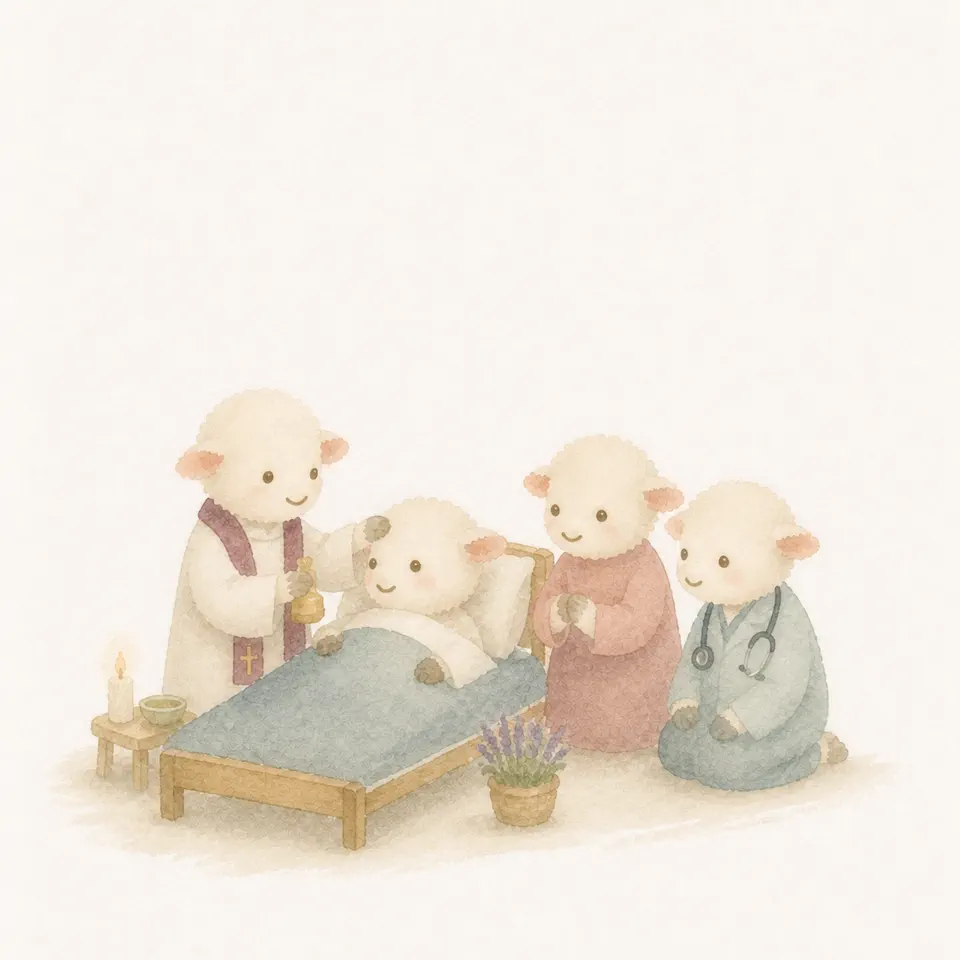
A watercolor of a priest lamb holding holy oil and laying a hand on a lamb lying in bed, while a lamb with folded hands and a lamb with a stethoscope keep watch beside a candle
  1. When is the right time to receive the Anointing of the Sick?

    Show the answer

    Answer ② Once serious illness or the frailty of age has begun to put a person in danger of death

    The old name “Extreme Unction” leaves many people thinking this is a sacrament for the last minutes of life, but the Church asks us to send for it as soon as serious illness or the frailty of age begins to put someone in danger. A slight illness, or advanced age on its own, is not what the sacrament is for.

    Catechism of the Catholic Church 1514, 1527-1528

  2. Who is able to celebrate the Anointing of the Sick?

    Show the answer

    Answer ③ Priests alone — that is, bishops and presbyters

    The ministers of this sacrament are priests alone: bishops and presbyters. A deacon may baptize and may witness a marriage, but he cannot anoint the sick; and religious or lay people may carry Holy Communion to a patient, yet the anointing itself is not theirs to give.

    Catechism of the Catholic Church 1516, 1530

  3. The Anointing of the Sick may be received only once in a lifetime.

    Show the answer

    Answer ② No

    No. Someone who gets well and later falls gravely ill again may receive it again, and even within one illness it may be repeated if the condition grows worse. Unlike Baptism, Confirmation and Holy Orders, this sacrament does not imprint an indelible character.

    Catechism of the Catholic Church 1515, 1529

  4. A gravely ill person who has lost consciousness and cannot confess still receives the forgiveness of sins through the Anointing of the Sick.

    Show the answer

    Answer ① Yes

    Yes. The forgiveness of sins belongs to the grace of this sacrament, so it washes clean even someone who was in no state to receive Penance. It is not a short cut that lets a person skip confession, though; it is the Church's care for one who has been put beyond the reach of confession.

    Catechism of the Catholic Church 1520, 1532

  5. Which of these states the grace of the Anointing of the Sick most accurately?

    Show the answer

    Answer ④ By the strength and comfort of the Holy Spirit it unites the sick person with the Passion of Christ, and it restores health as well if that is good for the salvation of the soul

    The Anointing of the Sick is neither a charm that forces a cure nor a piece of psychological comfort with no bearing on the body. The Church does ask for the recovery of health, teaching that it is given when it serves the salvation of the soul, and above all the sacrament gives the sick person strength, peace and courage, joining them to the Passion of Christ.

    Catechism of the Catholic Church 1520, 1532

  6. What is the last sacrament a Christian receives on leaving this world?

    Show the answer

    Answer ① Viaticum — the Eucharist received as death draws near

    The order the Church has prepared for someone leaving this world is Penance, then the Anointing of the Sick, then Viaticum, and the last of them — its high point — is the Eucharist. It is easy to take the Anointing of the Sick for the final sacrament, but the “food for the journey” given for the Passover crossing is the Eucharist.

    Catechism of the Catholic Church 1517, 1524-1525