Events in the Bible · Question 2
Adam and Eve took an apple from a talking snake?
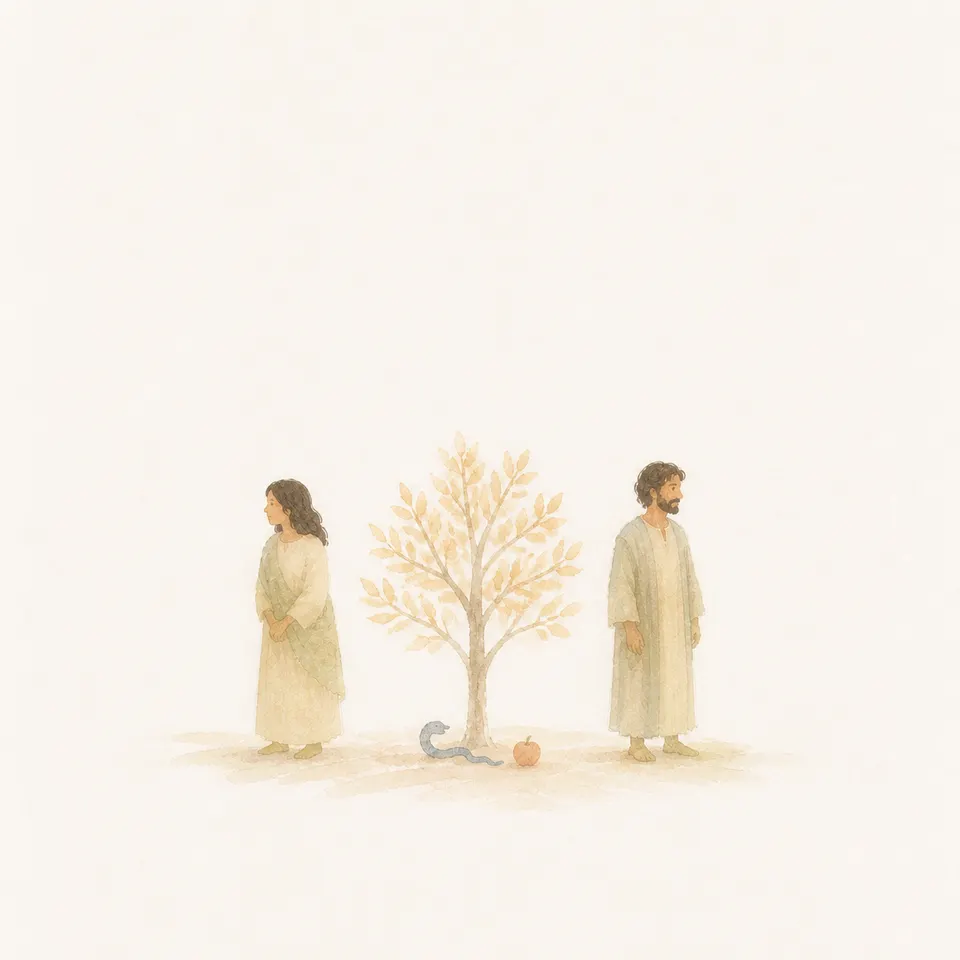
The question: “Does it make sense that every human being is punished because of one fairy-tale scene?”
The Church's answer: The word ‘apple’ does not appear in the text of Genesis. The Church teaches that Genesis 3 uses symbolic language and yet points to a primeval fall at the beginning of humanity, in which human beings distrusted God and misused their freedom. Original sin is not a personal crime committed by an infant; it is a wounded condition in which the first communion with God has been lost, the reality Christ came to heal.
An analogy — the first crack that spread through a family
A crack in a house's foundation is not the fault of a child born later, yet it affects everyone who lives there. An inherited injury and a person's own wrongdoing have to be told apart.
This analogy shows that the damage of an earlier choice can reach a shared life even without personal guilt. It does not mean that people are buildings or that original sin is a physical crack, and each person's freedom and responsibility remain intact.
If they press further: “Why should I be held responsible for someone else's wrong?” — It does not mean guilt is inherited. We are born into a world already tangled with selfishness and death, but each of us can freely learn to love and receive new life in the grace of Christ.
In one sentence: “It is not a story about an apple; it is the story of human beings misusing freedom from the start and breaking a relationship, and of Christ mending that wound.”